From Patrol to Enforcement. A Continuous Architecture of Control

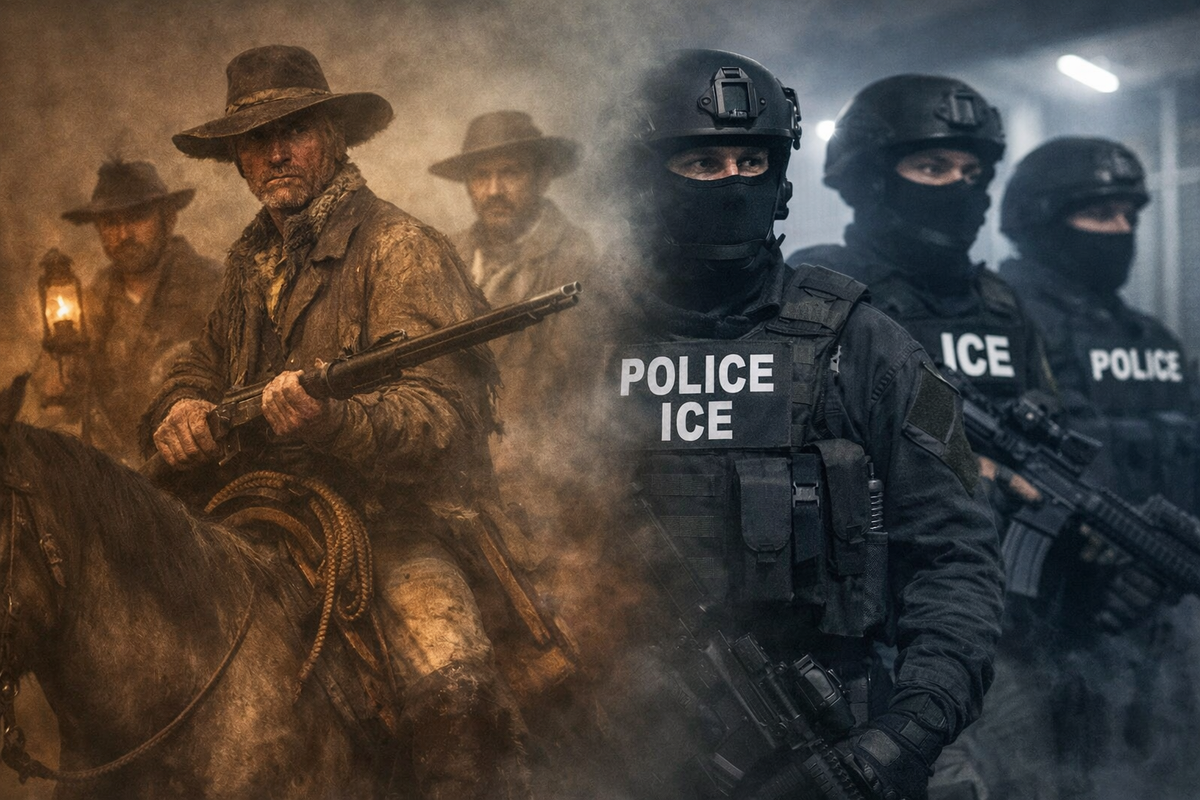
The American slave patrol was not an improvised brutality. It was an institution. Beginning in the early eighteenth century, most clearly in the Carolinas, colonial governments constructed organized patrols whose sole purpose was to regulate the movement, behavior, and imagination of an enslaved population. These patrols were empowered to stop, search, interrogate, and punish without warrants or judicial process. Papers mattered more than personhood. Presence without authorization was itself an offense. The patrol did not exist to resolve disputes or protect communities. It existed to preserve an economic system through fear.
What made slave patrols historically significant was not only their violence, but their legal logic. They were written into law as exceptions to normal restraint. The Constitution did not yet exist, but the pattern was already established. Certain people could be placed outside ordinary protections because their status was defined as a threat. This is the conceptual move that matters. Once the law accepts that some groups require special control regimes, enforcement becomes detached from justice and oriented toward containment.
After the Civil War, the patrol did not vanish. It reassembled itself through new forms. Reconstruction militias, Black Codes, and vagrancy statutes carried forward the same operational instincts. Movement was criminalized. Documentation became compulsory. Detention replaced ownership, but labor extraction remained. The Thirteenth Amendment’s punishment clause gave this transformation legal cover. Slavery was abolished in name, while coercive control was preserved in function. Policing became the mechanism by which racial and economic order was enforced under a new constitutional vocabulary.
As professional police departments expanded in the late nineteenth and early twentieth centuries, particularly in the South, they inherited patrol practices almost intact. Warrantless searches, population surveillance, and discretionary violence were not deviations from the system. They were its foundation. Jim Crow enforcement depended on police power to maintain segregation, suppress dissent, and discipline labor. The patrol’s logic survived by learning new justifications.
Immigration enforcement emerged within this same lineage. When modern border and interior enforcement agencies were formalized, they adopted many of the same structural features. Status replaced race as the explicit category, but the mechanics were familiar. Identification determined freedom. Absence of papers justified detention. Enforcement operated with broad discretion and limited judicial oversight. The constitutional rights of those targeted were treated as conditional, diluted by their classification as outsiders.
This is where the evolution becomes unmistakable. The contemporary practices of ICE did not arise in a vacuum. They reflect a long American habit of building parallel enforcement systems for populations deemed threatening to social order. Interior raids, civil detention without trial, and the routine separation of families echo older patrol mandates to disrupt gatherings, restrict movement, and return bodies to controlled spaces.
The detention camps that now anchor this system are not an aberration. They are the modern infrastructure that makes patrol-style enforcement sustainable at scale. Taxpayer-funded, often privately operated, and legally insulated, these facilities function as zones of reduced constitutional visibility. People are confined not for crimes adjudicated by a jury, but for status determinations made administratively. Forced labor, minimal compensation, and the charging of detainees for basic necessities reproduce an older pattern. Control is financed by the public. Discipline is outsourced. Accountability dissolves.
Defenders of this evolution insist on legality. Slave patrols were legal. Fugitive slave laws were legal. Jim Crow policing was legal. The appeal to law has always accompanied the narrowing of moral concern. What changes across eras is the language, not the architecture. Patrols become police. Police become enforcement agencies. Camps become processing centers. Each renaming softens the continuity without altering its function.
The throughline is not race alone, though race has always been central. The deeper continuity is the willingness of American institutions to suspend constitutional norms when confronting populations defined as dangerous, disposable, or temporary. Once that suspension is normalized, it becomes portable. Techniques migrate. Authorities expand. What begins with the enslaved, then the freedman, then the migrant, never remains confined to its original target.
Understanding immigration enforcement as the descendant of slave patrols is not about provocation. It is about historical clarity. The United States has repeatedly solved perceived social anxiety by inventing enforcement regimes that operate at the edge of the Constitution. Each generation convinces itself that this time is different. History suggests otherwise. The patrol survives not because it is named, but because it is forgotten.