
The Decade America Chose Minority Rule

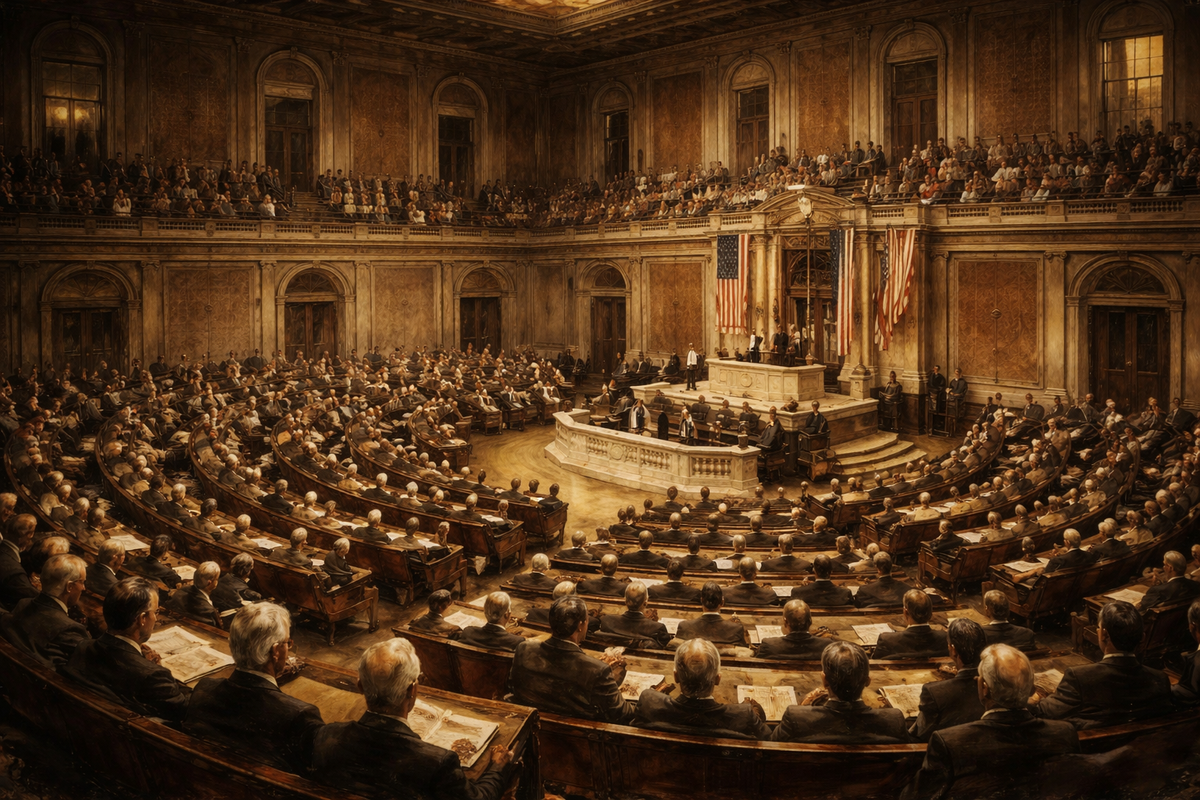
The census crisis of 1920 was not a footnote. It was a constitutional rupture that reshaped American democracy more quietly and more durably than many better-known scandals. For the first time since the founding, Congress received a census showing a nation transformed and then chose to do nothing. Urban America had overtaken rural America. Immigration, industrialization, and internal migration had altered the country’s political center of gravity. The Constitution required reapportionment. Congress declined to comply.
The resistance was not abstract or accidental. By 1920, for the first time in American history, a majority of the population lived in cities. This demographic shift threatened the political dominance of rural districts that had long controlled the House through malapportionment, seniority, and committee power. Urban representatives would mean labor unions with leverage, immigrant voters with influence, Catholic and Jewish constituencies with visibility, and political machines capable of mobilizing mass turnout. Rural lawmakers understood that reapportionment would permanently weaken their grip. So they stalled, not by arguing openly against representation, but by claiming the data was flawed, the process too complex, or the consequences too destabilizing.
The delay became a strategy. For ten years, Congress governed in open defiance of population reality. The House remained frozen at 435 seats distributed according to the 1910 census, even as cities exploded in size. By mid-decade, some urban districts had three times the population of rural ones. A vote in rural Indiana or Kansas carried far more weight than a vote in New York City or Chicago. This was minority rule maintained through procedural inertia.
The policy consequences were profound. The 1920s are often remembered as a decade of cultural excess and economic growth, but legislatively they were marked by restriction and repression. The Immigration Act of 1924 did not emerge in a vacuum. Its rigid national origins quotas reflected a Congress structurally insulated from the people most affected by immigration law. Urban immigrant communities were underrepresented by design. Their political power was diluted before debate even began. The same imbalance shaped labor policy. Efforts to strengthen worker protections repeatedly failed, while courts and lawmakers sided with employers during strikes and organizing drives. Prohibition enforcement, too, followed this distorted map, harshly applied in cities while rural violations were often ignored.
The refusal to reapportion also revealed a deeper institutional weakness. The Constitution assumed good faith. It mandated a census and implied that Congress would act on it. There was no enforcement mechanism beyond political pressure. When Congress discovered it could simply ignore its obligation without immediate consequence, a dangerous precedent was set. Constitutional duties became negotiable if compliance threatened entrenched power.
By the late 1920s, the dysfunction was impossible to ignore. Court challenges mounted. Editorial boards grew restless. Even some rural legislators worried about the legitimacy of a House that no longer reflected the nation. The result was the Reapportionment Act of 1929, often presented as a technocratic fix. It restored automatic reapportionment after each census, removing the need for a new act of Congress every decade. But the price of reform was structural compromise. The House was permanently capped at 435 members.
That cap solved the immediate embarrassment while locking in long-term distortion. As the population grew, representation became thinner. Districts ballooned. The average House district now contains more than 760,000 people, compared to roughly 210,000 in 1913. This dilution benefits incumbents, weakens constituent access, and amplifies the influence of money and media. It also entrenches geographic inequality. Less populous states retain disproportionate power through the Senate, while the House, meant to reflect population, grows increasingly abstract.
The civic lesson of the 1920 census crisis is not simply that Congress once broke the rules. It is that democratic erosion often occurs through nonaction rather than rebellion. No law was repealed. No amendment passed. The Constitution remained intact on paper while its core promise was suspended in practice. Power learned that delay could substitute for defiance.
This episode also reframes a common story Americans tell themselves. That democratic failure arrives suddenly, with spectacle and slogans. The reality is quieter. It arrives through procedural neglect, through claims of complexity, through appeals to stability that mask fear of change. The census crisis shows how easily representation can be hollowed out without a single vote cast against it.
That legacy persists. Modern debates over gerrymandering, voter suppression, and the Electoral College all rest on the same tension revealed in the 1920s. When demographic change threatens existing power, the response is rarely to argue against democracy outright. It is to redefine how, when, and whether representation applies. The decade Congress chose not to act remains one of the clearest demonstrations that minority rule in America was not an accident of history. It was a choice.