
The Gospel the Right Avoids

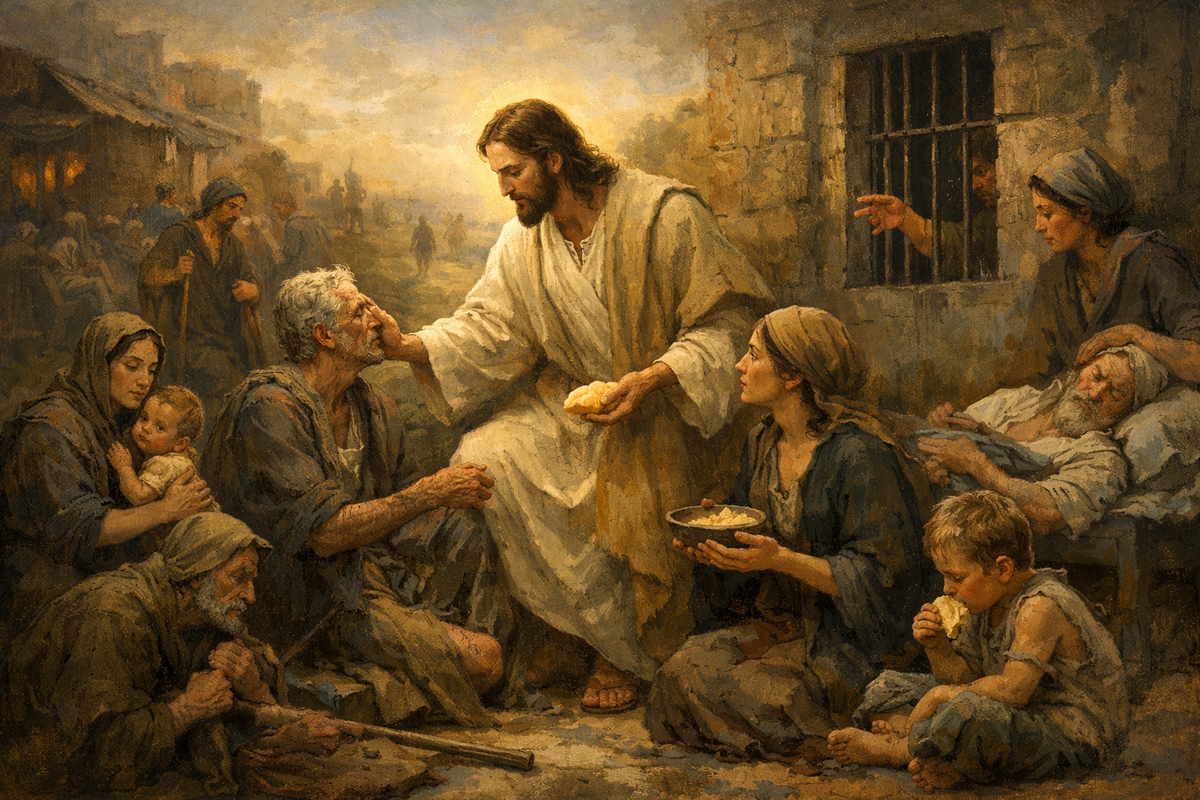
“I was hungry and you gave me food, I was thirsty and you gave me drink, I was a stranger and you welcomed me, I was naked and you clothed me, I was sick and you visited me, I was in prison and you came to me.”
Matthew 25:35–36
That passage is not a parable about private virtue or a poetic meditation on kindness. It is the judgment of nations. Jesus frames it explicitly as a standard applied to societies, not merely to individuals, and he grounds that standard in material obligations that cannot be fulfilled with belief alone. Feeding, housing, welcoming, caring, and visiting are not attitudes. They are actions that require resources, proximity, and political will. The final line removes any ambiguity. “Truly I tell you, whatever you did to one of the least of these brothers and sisters of mine, you did to me.” There is no theological loophole in that sentence.
This is why Jesus is easy to worship and hard to follow.
Matthew 25 offers no comfort to power. It does not celebrate order for its own sake or reward dominance masquerading as virtue. It does not treat poverty as evidence of moral failure or suffering as a deserved outcome. It does not allow societies to warehouse human beings in prisons and pretend the moral ledger ends at the prison gate. Instead, it drags the people a functioning system learns to ignore into the center of moral judgment and declares that this is where God stands.
The rest of the Gospels reinforce the same pressure rather than softening it. Jesus repeatedly warns against performative religion, especially piety practiced in public for recognition rather than accountability. Those who pray to be seen, he says, have already received their reward, which is status rather than righteousness. He rejects retaliation not because violence is impractical, but because it reshapes the moral imagination in ways that make cruelty feel justified. Turning the other cheek and loving enemies are not sentimental gestures. They are refusals to let violence dictate the terms of human worth.
When confronted with the question of taxes, Jesus refuses the temptation of holy rebellion. He does not sanctify resistance for its own sake or confuse civic obligation with ultimate loyalty. He tells his listeners to render what belongs to the state while keeping their allegiance to God uncorrupted by power. It is a teaching that denies both authoritarian worship of the state and religious fantasies of purity politics. It insists on moral clarity without theatrics.
Taken together, these teachings still read as politically disruptive. They demand material care rather than symbolic allegiance. They elevate conscience over performance. They reject vengeance as policy. They insist that the measure of a society is not its rhetoric, its borders, or its punishments, but how it treats people who cannot offer status, profit, or loyalty in return.
This is why American public Christianity so often prefers Moses to Jesus.
If Matthew 25 were posted on a courthouse wall or hung in a classroom, the argument would begin immediately. What do we owe migrants? What do we owe the poor? What do we owe prisoners? What do we owe the sick when care costs money, time, and political capital? Those questions are destabilizing because they convert belief into obligation. They force redistribution of attention and resources downward, away from institutions that already command respect and toward people who are routinely managed, blamed, or hidden.
Modern American conservatism has therefore elevated a different version of Christianity, one centered on identity, authority, and punishment. This version can be fused to nationalism without requiring nationalism to serve the vulnerable. It is compatible with hierarchy, carceral logic, and the moral language of threat. That substitution is not accidental. As historians like Kristin Kobes Du Mez have shown, much of modern white evangelical culture reshaped Christianity around ideals of masculine dominance, discipline, and strength, displacing the Jesus of the Gospels with a figure better suited to enforcing order than unsettling it.
The symbolic vocabulary follows naturally. Crusader imagery. Martial language. Appeals to holy violence sanitized as righteousness. “God wills it” was not a metaphor during the Crusades. It was a slogan used to justify slaughter. When modern political figures revive that imagery, the controversy is not about aesthetics or personal expression. It is about which Christianity is being signaled. The one rooted in Matthew 25, where power kneels before need, or the one that sanctifies power while the vulnerable learn to fear it.
Authoritarian movements in every era prefer a Christianity of symbols to a Christianity of obligations. Symbols unify without demanding sacrifice. Obligations redistribute moral attention. Matthew 25 does not allow a society to hide behind belief statements or national myths. It asks a simpler and more dangerous question. Who did you feed? Who did you welcome? Who did you visit when it was inconvenient and offered no reward?
That question remains as threatening to power now as it was two thousand years ago.