A Bit of a Nazi Streak

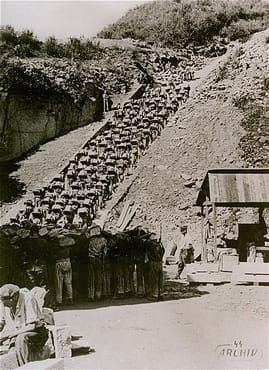
During the Second World War, the Mauthausen concentration camp in Austria became one of the most brutal sites in all of Nazi Europe. Built above a granite quarry, it was not designed for efficiency, production, or even interrogation. It was designed for death by exhaustion. Each morning, prisoners were driven down into the quarry, forced to heave massive slabs of stone onto their backs, and then ordered to climb the uneven staircase leading back to the camp—186 steps rising like a coffin lid toward the sky. The men were starved, beaten, and worked until their bodies collapsed. They called it the “Stairs of Death.”
This was not chaos. It was architecture. The Nazis turned a quarry into an execution ground. Those who stumbled were whipped, shot, or shoved from the ledge the guards called the “Parachutists’ Wall.” Some prisoners were ordered to jump. The guards laughed as they fell. By the time the camp was liberated in 1945, tens of thousands had died on those stones. The stairs still stand—scarred, silent, and uncomfortably patient—waiting for us to remember what happens when cruelty becomes a system.
Eighty years later, the echoes are growing louder.
Last week, Donald Trump’s nominee Paul Ingrassia was forced to withdraw after messages surfaced of him joking—not joking—about having “a bit of a Nazi streak.” He mocked Martin Luther King Jr. Day, Juneteenth, and Black History Month, while praising “competent white men” as natural rulers. It took rare dissent within his own party to stop the nomination—but the question remains: how did someone so openly admiring of fascist ideology come within arm’s reach of federal power?
The same question hangs over the recent leak of thousands of messages from Young Republican leaders—rising staffers, campaign workers, future officeholders—casually sharing Holocaust jokes, Hitler memes, racial slurs, rape fantasies. Not fringe militants. Not skinheads. Interns in Senate offices.
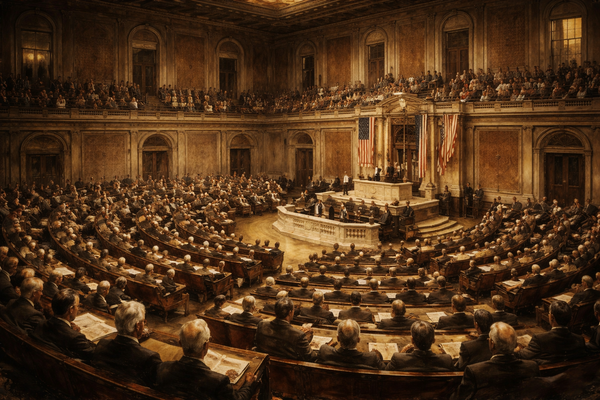
Then came the flag displayed in Congressman Dave Taylor’s office—an American flag reconfigured into a swastika pattern. The congressman condemned it as “inappropriate,” as though the issue were merely taste. But symbols placed inside the halls of power are not accidents. They are messages.
These are not isolated incidents. They are symptoms of permission. A drip-feed normalization. What was once hidden is now said aloud. What was whispered is now posted publicly. The ideology resurfaces not first as violence, but as humor. As irony. As just a joke. As something we are asked not to take too seriously.
But ideology always begins long before the first blow is struck.
At Mauthausen, the Parachutists’ Wall was the final step in a long chain of dehumanization. Before the first prisoner was thrown from its edge, there were jokes. There were slurs. There were speeches about purity, order, and strength. The men who pushed others to their deaths did not believe themselves to be monsters. They believed themselves to be patriots. They believed cruelty was necessary. They believed hierarchy was natural.
The stairs at Mauthausen are not just a ruin. They are a warning.
They remind us:
Evil does not announce itself with jackboots and banners.
It arrives laughing.
It arrives shrugging.
It arrives as a text message among colleagues:
“I do have a bit of a Nazi streak in me from time to time.”
The danger is never the first laugh.
The danger is when the laughter goes unchallenged.
We walk those steps again today. Upward toward vigilance, or downward toward repetition. The line between cruelty and civilization is only as strong as our refusal to treat dehumanization as entertainment.
The stairs are still there.
So is the choice.