Free and Fair™

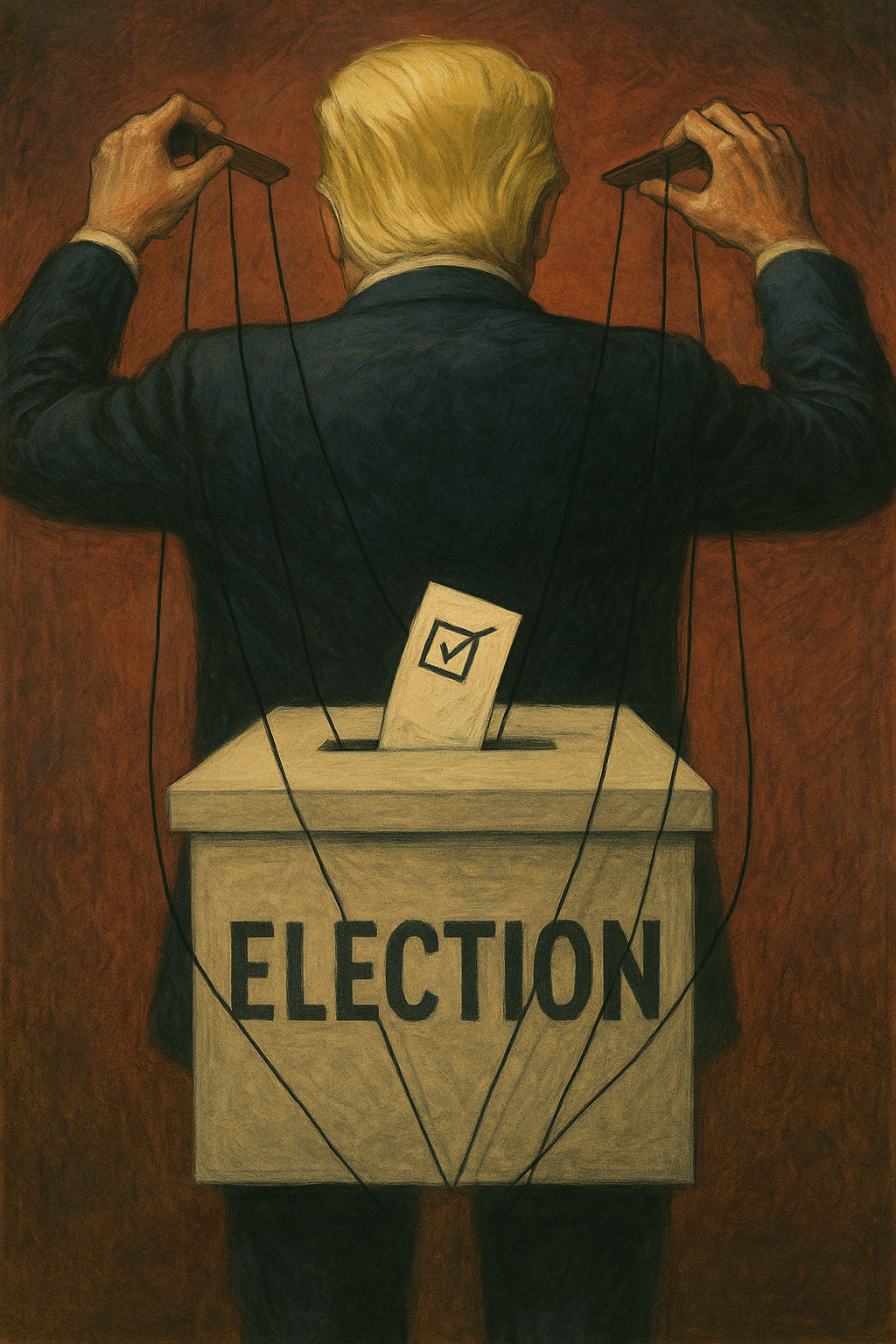
The story that is unfolding around the 2026 midterms is not just about candidates or polls—it is about the architecture of American elections themselves. Multiple reports indicate that Trump and his allies are actively developing plans to shape, influence, and potentially override the processes traditionally run by states. This is not speculation; this is policy in motion. The Associated Press reported that Trump has been explicit about his willingness to “use the vast powers of his office to prevent his party from losing control of Congress” in the midterms (AP). That framing alone tells us something: this is not about persuasion or votes, but about using executive authority as a strategic lever.
Parallel to partisan strategy is something far more consequential. The Brennan Center for Justice has tracked what it calls a “coordinated campaign to undermine American elections,” noting that many of the steps being taken are “unprecedented and in some cases illegal” (Brennan Center). These efforts include rewriting election rules to increase the burden on voters, pressuring or replacing election officials who refuse to align with the president’s directives, and reducing or eliminating federal oversight designed to protect voters from discrimination or interference (Brennan Center). In short, the aim is not merely to win an election—it is to restructure the environment in which elections occur.
The most alarming dimension, however, concerns the potential use of national emergency powers to federalize or override aspects of election administration. Cleta Mitchell, a conservative legal strategist closely tied to Trump’s previous election efforts, has openly discussed the possibility that Trump could “declare a national emergency to take control of elections.” This is not fringe rumor—it is planning in the open (Democracy Docket). Emergency powers in the United States unlock over a hundred extraordinary legal authorities normally inaccessible to the presidency, including the ability to redirect funding, deploy forces, restrict access, and bypass standard regulatory oversight (Protect Democracy).
And recently, a senior Trump-aligned election official, Heather Honey, was recorded saying that if the administration declared such an emergency, “we can take these other steps… we can mandate that states do things and so on.” She also admitted she was unsure “how feasible this is, or whether other people around the president would let him test that theory” (The Independent). The important thing here is not whether the plan is guaranteed to succeed—it is that a sitting administration is actively exploring whether a national emergency can be used to subordinate state-run elections to federal control in the name of election integrity.
If these structural maneuvers continue, the 2026 midterms become something more than a midterm: they become the testing ground. And the next presidential election—whether 2028 or sooner—would then take place under a new electoral landscape in which the executive branch has already reshaped the rules of participation, oversight, and certification. The goal is not simply to win once. The goal is to alter the playing field so that future elections are conducted under conditions favorable to the executive. A strategist from Fair Fight Action summarized the strategy clearly: “It’s a federal plan to control elections and rig our democracy.” (Fair Fight)
The strength of American democracy has always rested on one principle: power changes hands peacefully because the rules are stable, shared, and independent of the players who compete within them. The moment a president begins to rewrite those rules for advantage, or worse, to bypass the states themselves through emergency powers, we are not debating politics anymore. We are debating the continuity of the republic.
The question now is not whether this can happen—it is whether anyone will stop it.