From the Führer’s Hall to Trump’s Ballroom
Authoritarian leaders have always understood that the most enduring propaganda is not spoken but built. Speeches fade, posters peel, broadcasts end. But stone remains. Architecture becomes the stage on which a nation learns what to revere, what to fear, and what to remember. More importantly, it teaches who is meant to be remembered. And in every era where a single man attempts to stand in for an entire nation, the architecture of the state becomes the architecture of the self.
Mussolini knew this. When he took power in Italy, he did not simply raise new monuments—he rearranged the city of Rome to place himself within its mythology. Medieval neighborhoods were razed to carve a grand avenue from his office to the Colosseum, a direct symbolic inheritance from the Caesars. He spoke of himself as the restorer of Roman greatness, a figure who had arrived to return Italy to its rightful place in the world. The city’s stones became his script. The ruins of the empire were not preserved; they were staged. The imagery of the eternal Rome became the evidence of his legitimacy. Before him, chaos. After him, order. To question Mussolini was to question the inevitability of Rome itself.
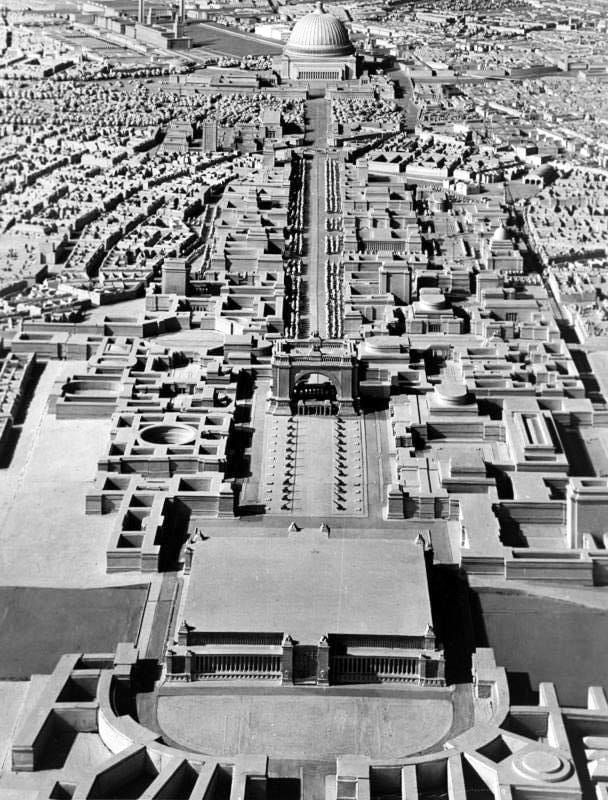
Hitler carried the same impulse, but magnified it to the scale of fantasy. He was not content to inherit history; he intended to overwhelm it. His vision for Germania, the planned capital of the Third Reich, centered on a structure that would dominate not just Berlin, but the world’s imagination. The Volkshalle, a domed hall capable of holding 180,000 people, was designed to make the human being feel miniature, diminished, swallowed by the state. “A people should feel small in the presence of its leader,” Albert Speer wrote. Architecture was not background—it was the emotional conditioning of obedience. To enter such a space was to be made aware that the leader was vast and the individual was trivial. A civilization was to be built around one ego, projected at monumental scale.
This is the historical pattern: architecture used not to serve a people, but to center a single man within the story of a nation. Buildings become mirrors in which the leader sees only himself—and demands that others see him, too.
Which is why Donald Trump’s recent proclamations about his proposed “National Garden of American Heroes,” the “Patriot’s Arch,” and the ballroom he describes as being “for me” are not merely tacky, boastful, or vain. They are ideological. They are part of a lineage. A leader who speaks of monuments “for me” is declaring that the nation is not the subject of history, but his possession. The architecture serves not memory, but self-mythology.
Trump’s aesthetic has always been one of spectacle: gold leaf, chandeliers, high ceilings meant not to inspire awe, but to broadcast wealth and dominance. He once said he prefers rooms where everything glitters because “people respond to gold.” It is not beauty he is pursuing, but submission. The ballroom that is “for me” is not a hall for civic gathering; it is a throne room in miniature. And the proposed monuments are not tributes to American history; they are attempts to inscribe his image into it.
The ego is the blueprint. The architecture is the argument. And the argument is that the nation and the man are one and the same.
But history teaches what these men refused to learn. The grandiose projects of fascist architecture do not stand as proof of greatness; they decay into monuments of delusion. Mussolini’s Foro Italico is cracked and crumbling. Hitler’s Zeppelin Field is a ruin of weeds and broken stone. The people outlast the tyrants, and the earth outlasts the ego.
So when a leader begins to speak of building monuments to himself, it is not patriotism speaking—it is warning. Democracies are built by many hands. Dictatorships begin the moment one man decides that the nation should be built in his image. And the foundation of such regimes always cracks, because no country can bear the weight of a single ego made of stone.