Nazi Town, USA
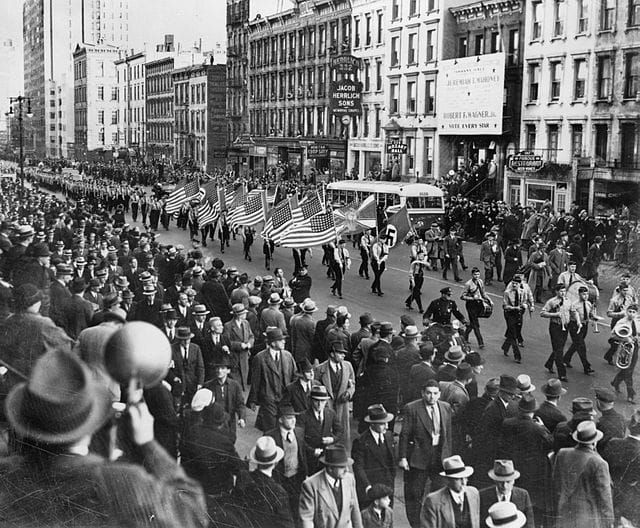
The German American Bund was not a fringe curiosity—it was the American face of Nazism, a movement that flourished in plain sight long before World War II. Led by Fritz Kuhn, a naturalized German immigrant who fancied himself the “American Führer,” the Bund wrapped Hitler’s fascism in the stars and stripes. They called themselves patriots, organized parades, built Nazi-style youth camps across the U.S., and preached that “real Americans” were white, Christian, and of Northern European descent. Their stated mission was to “defend America” from so-called “Jewish communism” and “racial mixing.” It was a blueprint for how white nationalism could be dressed up as patriotism.
Their most infamous event, the 1939 Madison Square Garden rally, made this perfectly clear. Beneath massive banners of swastikas and American flags, a 30-foot portrait of George Washington presided over the stage. As 20,000 supporters raised their arms in Nazi salute, the American anthem blared through the speakers, and Kuhn shouted, “We, with American ideals, demand that our government be returned to the people who founded it. If you ask what we are marching for—America First!” He called President Roosevelt “Rosenfeld,” mocked the “Jew Deal,” and urged the crowd to “stop Jewish domination of Christian America.” The audience roared. Outside, more than 50,000 anti-fascist protesters clashed with police while a lone man stormed the stage and was beaten by Bund guards. This was not Germany—it was New York City. And it revealed something haunting: fascism didn’t need to be imported. It was already here, fluent in American iconography.
That’s because the intellectual soil for fascism had already been tilled by American eugenics and racial hierarchies. In the early 1900s, eugenics—born from the same pseudoscientific obsession with “racial purity” that Hitler would later adopt—was mainstream policy in the U.S. More than 30 states passed laws mandating sterilization of people deemed “unfit,” from the poor and mentally ill to minorities. In Buck v. Bell (1927), Justice Oliver Wendell Holmes infamously declared, “Three generations of imbeciles are enough.” Between 1907 and the 1940s, over 60,000 Americans were forcibly sterilized, and the Nazis explicitly cited these laws as inspiration for their own. The United States didn’t just tolerate fascist ideas—it pioneered many of them.
And while Nazism rose in Germany, white supremacist movements in the U.S. like the Ku Klux Klan were already practicing their own brand of racial terror. The KKK, founded in 1865 by Confederate veterans, evolved from a postwar vigilante group into a national political machine by the 1920s. They claimed over four million members—judges, sheriffs, pastors, senators, and police officers among them. They called themselves “100% American,” wrapped their violence in Christian fundamentalism, and targeted not just Black Americans, but Catholics, Jews, and immigrants. Their slogans and speeches spoke of “saving America,” “protecting our heritage,” and “defending Christian civilization.” They were the original culture warriors—defining “real Americans” through blood, faith, and obedience. The Klan’s rallies, complete with burning crosses and American flags, mirrored the fascist pageantry that would later define Mussolini and Hitler’s regimes.
The phrase “America First”—which the Bund used in 1939—didn’t start with Donald Trump. It began during World War I and gained power in the 1920s and ’30s through nationalist and isolationist groups that opposed immigration and foreign wars while pushing for racial purity at home. Charles Lindbergh, one of the era’s most famous figures, became its face when he warned against “the Jewish influence” in American media and politics. “America First” was not a call for unity—it was a slogan of exclusion, insisting that certain people didn’t belong in the American story. The phrase “Make America Great Again” later drew from the same well—nostalgia for an imagined past of racial hierarchy, gender control, and Christian dominance. It’s the same myth that fueled both the Bund and the Klan: that the nation’s strength depends on purity and obedience, not diversity and equality.
Fascism, stripped to its essence, is the violent enforcement of purity—of race, religion, or nation—through centralized authority and mythic nostalgia. It thrives on the fantasy of a lost greatness that can only be restored by eliminating or subordinating “others.” That is why fascism and white nationalism are not separate ideologies—they are two faces of the same creed. Fascism wraps racial supremacy in patriotism; it tells its followers that domination is love of country. It glorifies obedience, silences dissent, and rebrands cruelty as order.
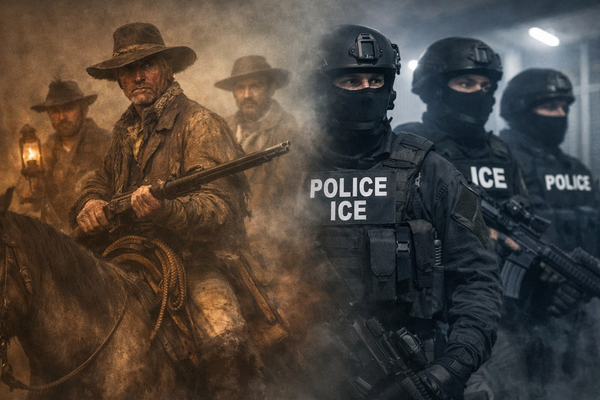
Today, we see those same rhetorical weapons recycled. People are called “Nazis,” “Marxists,” “Communists,” or “Fascists” not as accurate descriptions, but as bludgeons to confuse and divide. This is not just lazy—it’s a deliberate tactic. Mislabeling and distortion are tools of gaslighting. When everyone is called a fascist, no one recognizes the real one. It’s how movements rooted in white nationalism can masquerade as populism, how authoritarianism hides behind flags and hymns, and how “America First” rhetoric can echo straight from the playbook of the Bund and the KKK.
The 1939 rally at Madison Square Garden was not an anomaly—it was a warning. It showed that fascism doesn’t have to invade from abroad; it can grow in the heart of a democracy, disguised as patriotism and moral revival. The same forces that burned crosses in the South and raised swastikas in New York are the ones that now whisper about “taking our country back.” History isn’t repeating—it’s remembering. And it’s up to us to call it by its name.