Out of Many, One — or In God We Trust: The Battle Over America’s National Motto
For nearly two centuries, the United States spoke of itself through a simple Latin phrase: E Pluribus Unum — “Out of many, one.” It was the emblem of a fragile experiment, a declaration that a scattered collection of colonies, divided by culture, economy, and religion, could fuse into a single republic. When Franklin, Adams, and Jefferson proposed the motto in 1776 for the Great Seal, they were asserting not divine favor, but a political ideal. Unity was not a given; it was an achievement. The phrase adorned coins, seals, and documents, quietly stitching together a sense of belonging from diversity. It captured the founders’ secular vision of a civic nation — one bound by a constitution, not a creed.
But history is never static, and national symbols are living reflections of their times. During the crucible of the Civil War, another phrase emerged from the national conscience: In God We Trust. First appearing on a two-cent coin in 1864, it was born not from constitutional debate but from wartime desperation. As Americans slaughtered one another in the name of union and freedom, many sought reassurance in providence. Letters poured into the Treasury demanding acknowledgment of “Almighty God” on the currency. The new phrase didn’t replace E Pluribus Unum, but it coexisted — a whispered prayer beneath a battered flag.
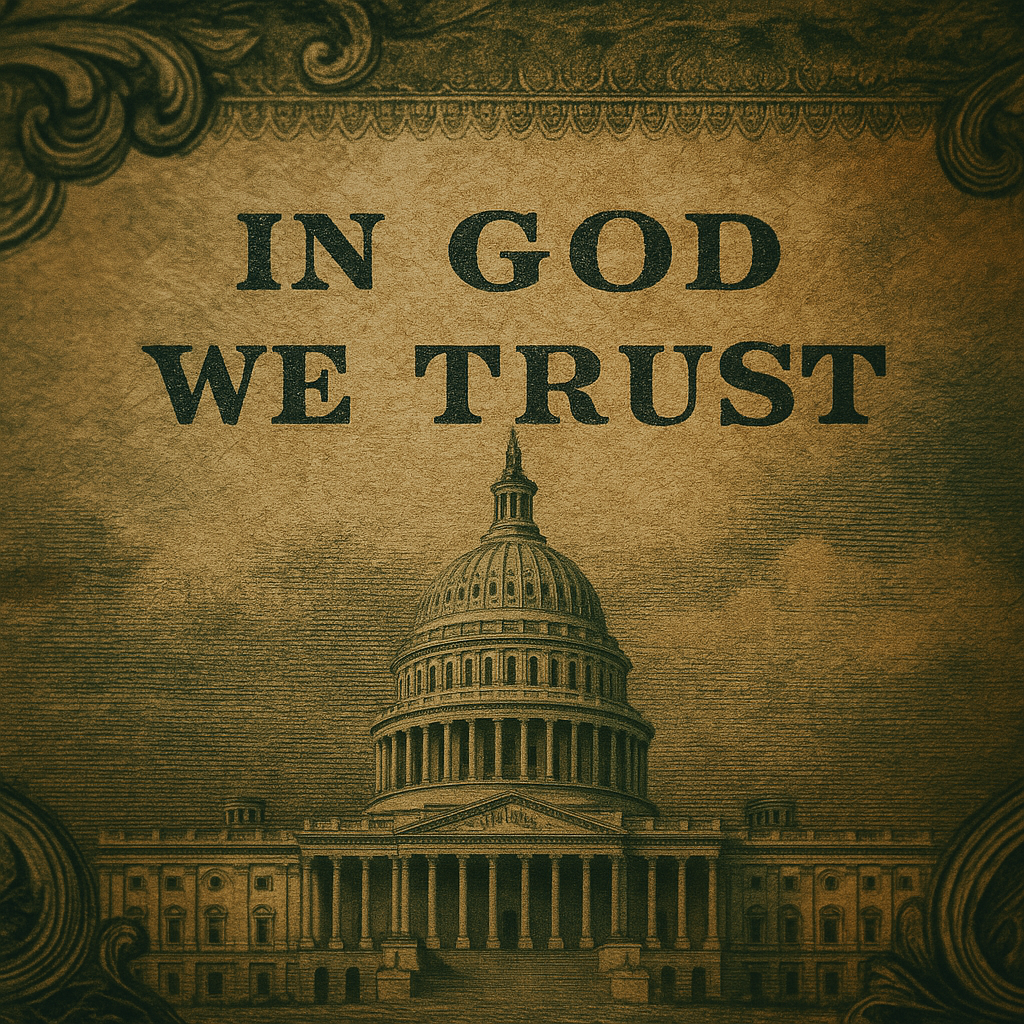
For decades, both mottos shared the nation’s imagery. Yet the real transformation came not amid war, but during peace — the uneasy peace of the Cold War. In the 1950s, America defined itself against the “godless communism” of the Soviet Union. Public life grew steeped in religious expression: Congress added “under God” to the Pledge of Allegiance, and President Eisenhower signed a law in 1956 making In God We Trust the official national motto of the United States. One year earlier, Congress had required the phrase to appear on all U.S. currency. It was, as some historians have noted, an ideological act as much as a spiritual one — a way to mark moral contrast in a bipolar world.
That change represented more than just a religious revival; it marked a philosophical shift in how America saw itself. The founding motto, E Pluribus Unum, spoke of human effort — many people forging one identity. It was aspirational, civic, and inclusive. The newer motto, In God We Trust, placed national faith in divine oversight, suggesting that unity and strength flowed from belief rather than from shared citizenship. In the shadow of the Cold War, the substitution made sense: the U.S. sought moral high ground through piety. But in retrospect, it also foreshadowed the deep intertwining of religion and politics that would define later decades.
Even today, both mottos coexist uneasily. E Pluribus Unum still graces the Great Seal, the coins, and the Senate emblem. It remains etched into stone at the heart of the Republic — a silent reminder of a pluralistic ideal. Yet In God We Trust dominates public currency, courtrooms, and even classroom walls. It has been defended in the courts as ceremonial, challenged as sectarian, and invoked in politics as proof of moral virtue. Together, they reveal the dual soul of the American experiment: one civic, one spiritual; one forged by reason, the other by faith.
The choice between the two mottos is not merely about words, but about identity. E Pluribus Unum imagines a republic built by its citizens — imperfect, diverse, self-reliant. In God We Trust invokes divine guidance amid uncertainty. Both reflect truths about the American story. Yet their tension continues to echo in the nation’s conscience, a reminder that America has always been wrestling not only with who it is, but with who it wishes to be — a people united by creed, or by faith.