Sick for Profit. How American Health Care Became a Drag on National Welfare

For most of American history, health care was not organized as a profit-maximizing industry. It was local, uneven, and often unjust, but it was constrained by social norms rather than financial engineering. Doctors were independent practitioners. Hospitals were largely charitable or religious institutions. Payment was direct and limited by what communities could bear. Illness was a hardship, but it was not yet a revenue stream optimized at scale. The transformation of health care into one of the most expensive and extractive sectors of the American economy is recent, deliberate, and inseparable from policy choices that now undermine national welfare.
The first turning point had little to do with medicine. During World War II, wage controls pushed employers to compete for workers through benefits instead of pay. Health insurance emerged as a workaround. When the federal government exempted employer-sponsored insurance from income taxation, it quietly locked this arrangement into place. Coverage became tied to employment by accident rather than design. Risk pools fractured. The unemployed, the elderly, and the poor were left exposed. Other industrial nations, rebuilding after the war, moved toward universal systems that treated health care as social infrastructure. The United States treated it as compensation.
Medicare and Medicaid, created in the 1960s, filled moral gaps but preserved the underlying structure. They expanded access without challenging private insurance dominance or fee-for-service incentives. For a brief period, outcomes improved and costs rose slowly. That balance ended in the 1970s, when health care began its full transition into a for-profit industry. Investor-owned hospital chains expanded rapidly. Insurance companies consolidated and refined risk selection. Health Maintenance Organizations reframed patients as utilization problems to be managed. Federal policy increasingly deferred to market logic even as health care became less and less suited to market discipline.
From that point forward, costs detached from value. The United States now spends more on health care than any other country, by a wide margin. In 1970, per-person health spending was roughly $350. By 2023, it had risen to about $14,500 per person, consuming nearly 18 percent of GDP. Comparable wealthy nations spend roughly half as much per capita while achieving better outcomes on life expectancy, infant mortality, maternal health, and preventable deaths. This is not a story of superior care. It is a story of pricing power, administrative excess, and incentives that reward volume and complexity over health.
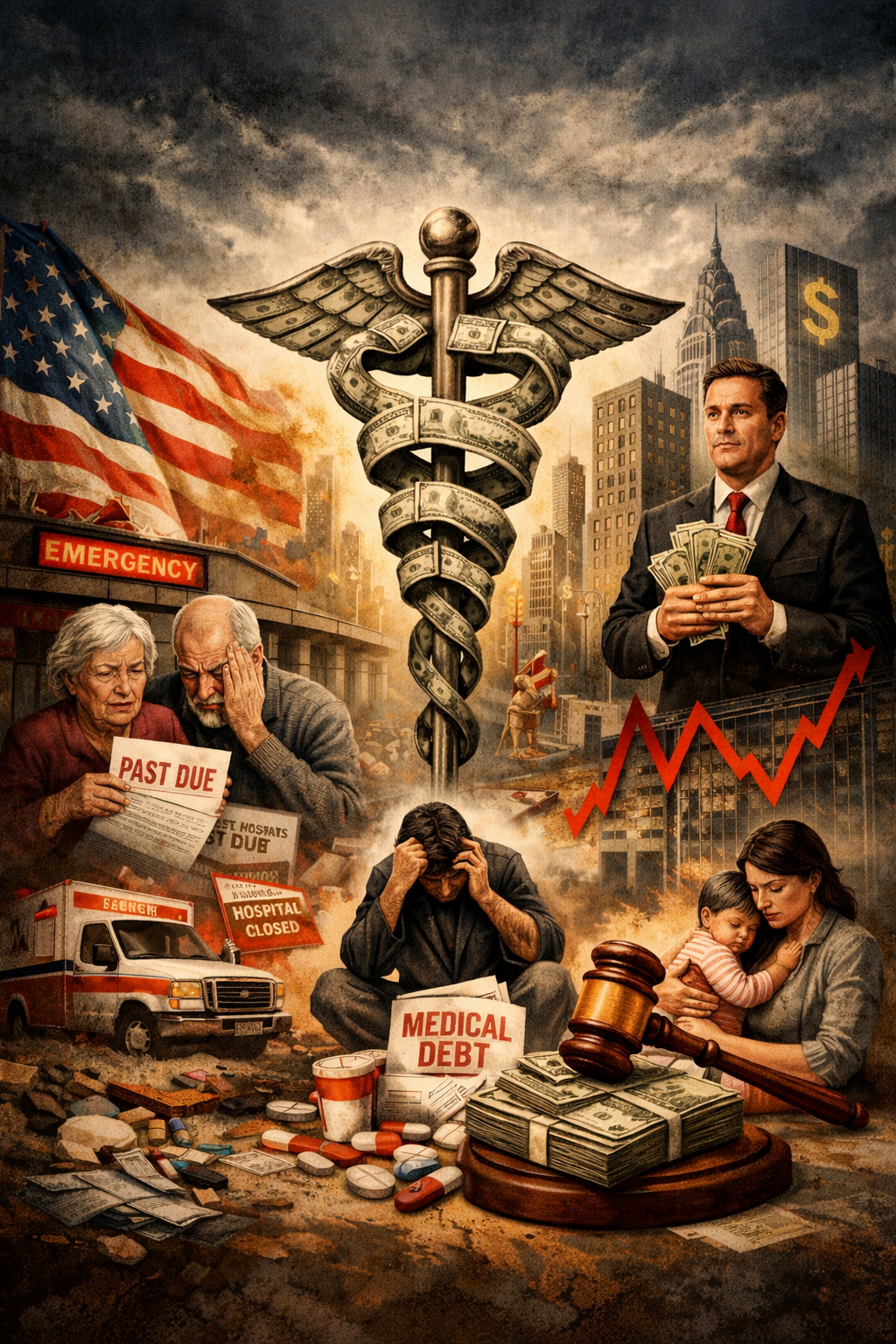
The damage to American welfare is structural. Households bear rising premiums, deductibles, and copayments that function as a hidden tax on wages. Medical debt remains a leading cause of bankruptcy, even among the insured. Fear of cost delays care, turning manageable conditions into emergencies that are both deadlier and more expensive. Preventive care is skipped not out of ignorance but rational avoidance of a confusing and punitive system. Illness becomes a liquidity crisis, and that instability ripples outward into work, family life, and long-term security.
The labor market absorbs the shock as well. Employer-based insurance traps workers in jobs they cannot afford to leave. Entrepreneurship declines. Geographic mobility shrinks. Wages stagnate as health benefits consume compensation growth. American businesses face higher labor costs than competitors in countries with universal systems, weakening global competitiveness. What is framed as private choice quietly constrains freedom of movement and economic dynamism.
Public finances suffer in parallel. Federal and state governments spend vast sums subsidizing private insurance markets, purchasing care at inflated prices, and backstopping market failures. These expenditures crowd out investment in education, housing, infrastructure, and public health. The irony is persistent. The United States spends more on medical treatment than any other nation while underinvesting in the social conditions that actually produce health. The result is high rates of chronic disease, mental illness, addiction, and maternal mortality feeding back into an already strained system.
The Affordable Care Act emerged against this backdrop. It was not a revolution. It was a containment effort. The law expanded coverage, banned some of the most destructive insurance practices, and reduced the direct financial exposure of millions of households. After its implementation, the uninsured rate fell sharply, reaching historic lows in subsequent years. Medicaid expansion, in particular, produced measurable welfare gains. Large studies found significant reductions in mortality among those who gained coverage. Tens of thousands of lives were saved not by medical breakthroughs, but by access.
On costs, the ACA’s achievements were more modest but still meaningful. It did not dismantle the pricing system that drives American health care inflation, yet it reduced out-of-pocket burdens for many families and slowed cost growth in certain periods. National health expenditure growth reached historic lows around 2009 and 2010, and while much of that slowdown reflected recession-era dynamics, it demonstrated that policy and utilization changes could affect the trajectory. More importantly, the law redistributed risk away from households least able to bear it. That is welfare in its most concrete form.
The limits of the ACA were not accidental. They were political. From the beginning, health care and insurance interests mobilized to shape and constrain reform. Lobbying around health reform reached unprecedented levels, with thousands of lobbyists working Congress during the debate. Industry opposition helped kill the public option, which could have provided a stronger pricing benchmark and bargaining counterweight. Instead, the law expanded coverage largely by subsidizing private plans, preserving the market structure that generates high costs in the first place.
After passage, opposition did not subside. Republican lawmakers voted repeatedly to repeal or undermine the law. In 2017, repeal efforts came within a single Senate vote of success. The Congressional Budget Office estimated that the House-passed repeal bill would have increased the number of uninsured Americans by roughly 23 million within a decade. During that debate, Senator Shelley Moore Capito captured the moral stakes when she said, “I did not come to Washington to hurt people.” The statement endures because the consequences were not abstract. Losing coverage predictably means delayed care, higher mortality, more uncompensated emergency treatment, and deeper household debt.
When outright repeal failed, a quieter strategy followed. Subsidies were weakened. Enrollment assistance was cut. Administrative hurdles increased. Healthier people exited first, premiums rose, and markets destabilized. More recently, the looming expiration of enhanced ACA subsidies threatens to raise premiums sharply and push millions out of coverage if Congress does not act. Each step follows the same welfare logic. Make coverage less affordable, and illness becomes more financially destructive. The costs do not disappear. They reappear later, larger, and borne by families, hospitals, and public budgets.
The role of money in this resistance is not subtle. Health care interests are among the largest and most consistent spenders on lobbying in Washington, with pharmaceutical and health product companies alone spending billions over decades. These investments narrow the range of reforms deemed politically acceptable. Proposals that would impose real price discipline, such as broader public bargaining power or simpler universal financing, are framed as unrealistic or dangerous, even as the existing system demonstrably harms national welfare.
The Affordable Care Act therefore stands as both a success and a warning. It shows that policy can reduce harm, save lives, and stabilize households. It also shows how difficult it is to reform a system whose profits depend on fragmentation and opacity. As long as health care is treated primarily as a market rather than a public good, costs will rise faster than wages, access will remain conditional, and welfare will continue to erode.
A society cannot sustainably organize its health system around extraction without paying the price elsewhere. In the United States, that price is visible in shorter lives, weaker labor markets, strained public budgets, and a persistent sense of insecurity tied to illness. Health care is not merely another sector of the economy. It is the foundation on which economic participation and civic stability rest. When that foundation is unstable, the damage spreads quietly but relentlessly across the entire republic.