Standing Alone

Welcome to The Civic Algorithm
Thank you for joining me on this journey.
This project began from a simple but pressing need — to make sense of the world around us at a time when truth feels increasingly fractured. We each see only a piece of the picture, like the old parable of the blind men and the elephant: one feels the trunk and says it’s a snake, another the leg and says it’s a tree, another the ear and says it’s a fan. Each is partly right, but none see the whole.
My goal with The Civic Algorithm is to use every tool available — from the latest large language models to traditional research, historical context, and peer-reviewed data — to build a more complete understanding of that “elephant.” AI helps me process vast amounts of information, structure arguments, and surface connections that would otherwise take months to uncover. But the interpretation — the narrative — remains my own.
Each post is an experiment in synthesis: blending history, data science, and lived experience to construct a coherent mental model of our civic reality. I don’t claim to have every answer, but I believe that by using these tools thoughtfully and transparently, we can get closer to the truth — layer by layer.
Thank you for being here at the start. Together, we’ll explore how technology, power, and democracy intertwine — and what that means for all of us.
— The Archivist
The Civic Algorithm
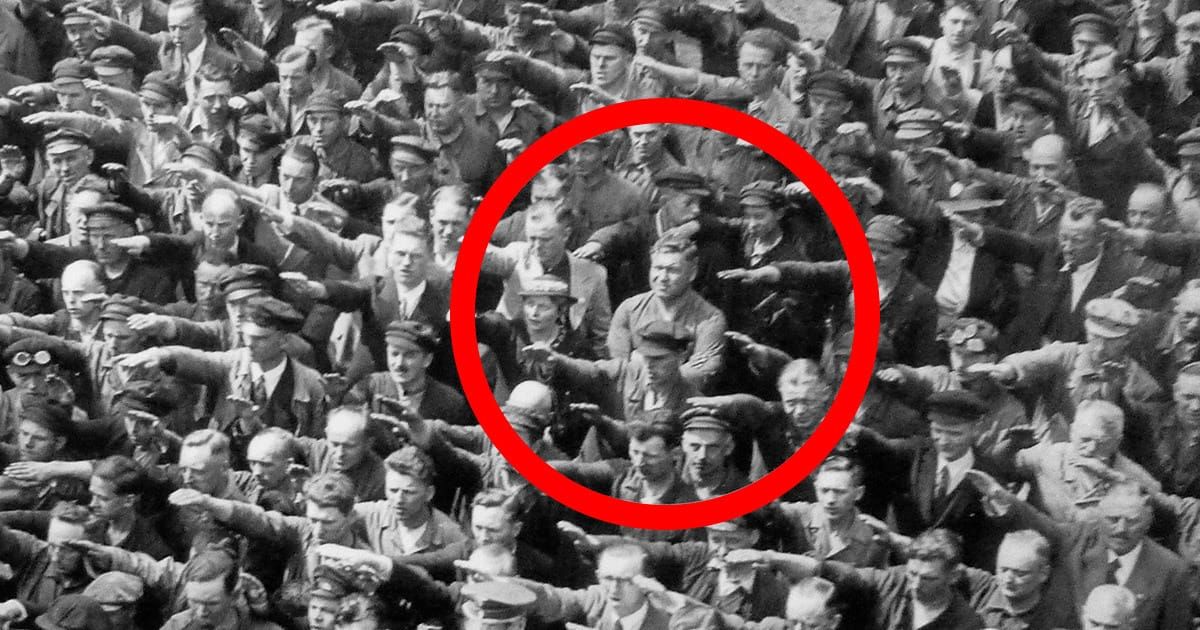
In 1936, at a Nazi rally in Hamburg, one man—August Landmesser—stood with his arms folded while everyone around him gave the Nazi salute. Landmesser had fallen in love with a Jewish woman, was expelled from the Nazi Party for refusing to abandon her, and later lost both her and his own life to the regime. That single act of defiance, captured in a photograph, endures as a reminder that sometimes the most powerful resistance is simply refusing to go along.
The people you allow closest to you reflect the morals and ideals you believe in. When folks believe ripping families apart, destroying lives, imposing their religious views on others, and supporting overtly racist policies are acceptable, they are telling you exactly who they are. For a long time, I tried satire, reason, and even embarrassment to show MAGA friends the damage they enable. It hasn't changed the views of a single friend or family member of mine. You cannot have a policy debate with someone who thinks God is on their side while locking up children in places called Alligator Alcatraz.
The “Fox News effect” describes how viewers of Fox News often end up less informed than people who watch no news at all, because the network blends selective coverage, partisan framing, and outright misinformation. Studies from places like Princeton and the University of Chicago have shown that Fox viewers consistently hold false beliefs about politics, policy, and even basic facts. This constant reinforcement creates a closed information bubble where MAGA supporters see disagreement as betrayal, not debate. When someone is convinced their neighbors are “enemies within,” reasoning with them becomes nearly impossible—they aren’t engaging with reality, they’re defending a narrative.
The Founding Fathers placed the First Amendment at the very top of the Bill of Rights because they knew firsthand the dangers of government suppressing thought, religion, and dissent. Having lived under British rule where criticism of the Crown could mean prison, they wanted to guarantee that Americans could freely speak, publish, and worship without fear. As James Madison wrote, “The people shall not be deprived or abridged of their right to speak, to write, or to publish their sentiments.” Thomas Jefferson called freedom of conscience “the most inalienable and sacred of all human rights.” They understood that without freedom of speech, press, assembly, and religion, democracy itself cannot survive—because truth and accountability disappear the moment the government dictates what people can say or believe.
The very foundation of our democracy rests on the idea of a social contract—that citizens give up a measure of absolute freedom in exchange for a government that protects their rights and serves the common good. Thinkers like John Locke and Jean-Jacques Rousseau influenced the Founding Fathers with the principle that government legitimacy comes only from the consent of the governed. When leaders begin weaponizing laws to silence dissent, persecute minorities, or strip people of their basic dignity, they break that contract. And when the contract is broken, citizens not only have the right but the obligation to withdraw their consent and hold those leaders to account as well as their enablers.
Now, with Trump’s most recent executive order, dissent itself is labeled terrorism: “Common threads animating this violent conduct include anti-Americanism, anti-capitalism, and anti-Christianity; support for the overthrow of the United States Government; extremism on migration, race, and gender; and hostility towards those who hold traditional American views on family, religion, and morality.” This doesn’t just target violent actions—it paints entire belief systems, and therefore tens of millions of Americans, as enemies of the state.
History shows where this leads. In 1934, Hitler passed the Law Against Malicious Gossip, which criminalized criticism of the Nazi Party and encouraged people to report their coworkers, neighbors, and even family members to the authorities. Refusing to denounce your own friends could make you a criminal. The parallels are chilling. With this new executive order, I can easily imagine future requirements for clearance holders and government workers to begin reporting on their liberal or even simply not MAGA family members just to protect their own livelihoods.
And while people argue online, last night in Chicago immigrant children were dragged from their beds at gunpoint and thrown naked into the back of U-Haul vans. That’s not theoretical—that’s real. All while, my MAGA friends and family will look away because it didn’t happen to their children. That silence is permission. The only thing necessary for the triumph of evil is for good people to do nothing.
Psychologically, their loyalty is deep for those inside their tribe, but it seemingly vanishes for anyone outside of it. They will fight and sacrifice for each other, yet turn their backs when children are terrorized in the night. That double standard is not an accident—it is rooted in how humans process group identity. Social Identity Theory shows that once people define themselves as part of an “in-group,” their sense of morality is applied selectively: compassion, empathy, and sacrifice flow freely to insiders, but outsiders are dehumanized or treated as threats. Add to this “motivated reasoning,” where people filter information to protect their worldview, and you see why evidence of cruelty is dismissed or excused. There’s also the “authoritarian personality” dynamic, where obedience to leaders and hostility toward perceived enemies reinforce each other. When propaganda and partisan media amplify these instincts, it creates a worldview where defending one’s tribe—no matter what—is virtuous, and recognizing the humanity of outsiders is weakness. That is why their so-called “love” feels deep, but only so long as you remain inside the circle.
So I’ve begun distancing myself, one relationship at a time. It is the only way left to help those I love feel, even in part, what they have allowed others to endure. They’ve turned their backs on fellow Americans and the most vulnerable—so now I turn my back on them. This has meant disconnecting from my own family and closest friends, people I’ve known for over a decade. Ending relationships over politics alone would be wrong, but this is not politics—this is about morals. To continue supporting what is happening speaks louder than any words, and I cannot ignore it. The people closest to me must embody the ideals I want to see in the world. Enough is enough. I love these people deeply, but if my silence and absence are the only protests left to me, then so be it.