The Ancestry of Ideology: How Ancient Faiths Became Modern Politics
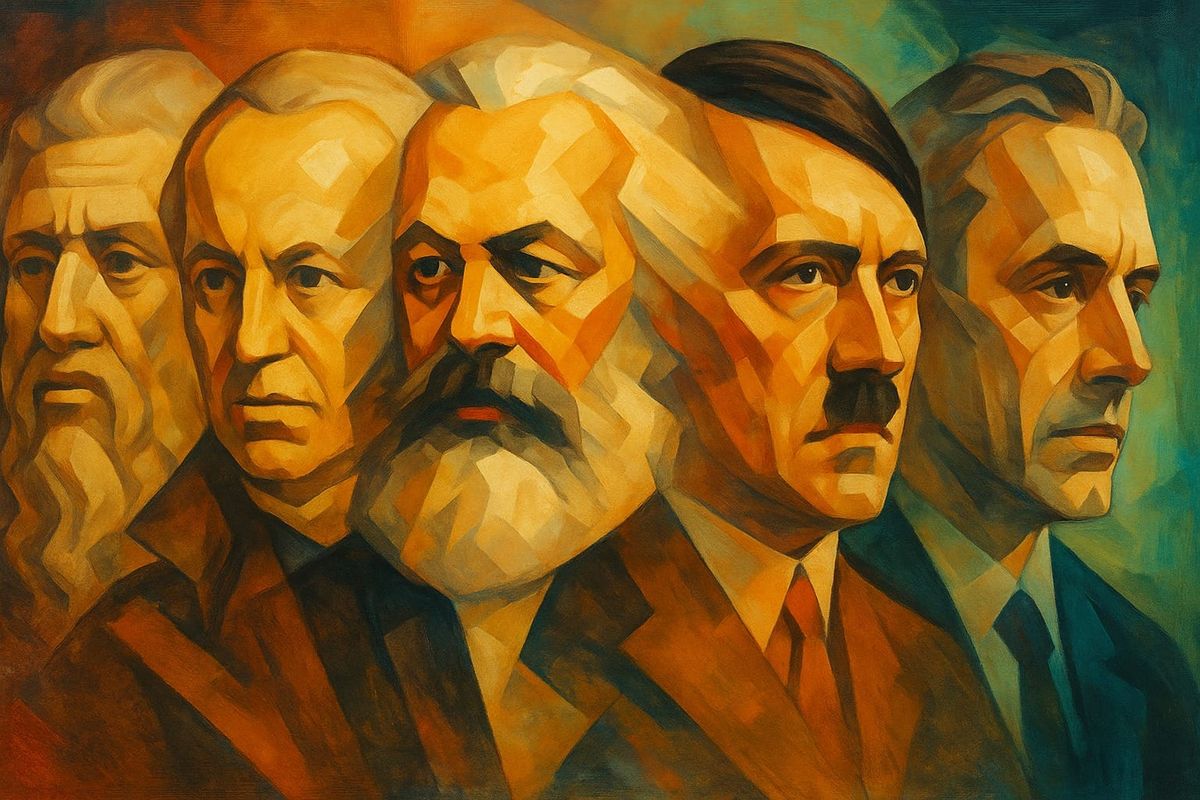
Modern political movements did not emerge from a vacuum. They are the product of thousands of years of philosophical evolution — a long conversation stretching from ancient mystics and early thinkers to the modern ideologues who shaped the 19th and 20th centuries. Every major political theory — from socialism and fascism to liberalism and conservatism — carries with it traces of older questions about the nature of man, power, morality, and the divine. To understand where modern movements come from, we must look far beyond politics itself and into the ancient roots of belief.
The story begins long before the Enlightenment, even before recorded philosophy, among the ancient Indo-European cultures whose myths and ideas shaped much of what became the Western world. Early Greek thinkers like Thales, Pythagoras, and Heraclitus inherited religious and metaphysical ideas from the Near East and reworked them into philosophy. Thales sought the single “substance” behind all things. Heraclitus saw the universe as a constant struggle of opposites — a tension that gives birth to life. “War,” he wrote, “is the father of all things.” This concept of dialectical conflict — the notion that creation comes through contradiction — would reappear centuries later in the philosophy of Hegel and, through him, in the doctrines of both Marxism and Fascism.
As Greek thought matured, it passed through Plato and Aristotle into the political and spiritual architecture of Rome and early Christianity. Plato’s vision of a perfect, ordered society guided by philosopher-kings became one of the most enduring blueprints for utopian politics. “Until philosophers are kings,” he wrote in The Republic, “cities will have no rest from their evils.” Aristotle, meanwhile, grounded philosophy in the study of nature and purpose, shaping not only logic and science but also the idea that hierarchies and order were intrinsic to the good life. Christianity absorbed both currents — Plato’s idealism and Aristotle’s teleology — and fused them into theology. Saint Augustine saw the City of God as the divine counterpart to the flawed city of man, while Thomas Aquinas reconciled faith and reason, declaring that “grace does not destroy nature but perfects it.” For over a millennium, this synthesis defined Europe’s moral and political imagination.
The Renaissance and Enlightenment shattered that synthesis. As humanism and science rose, the Church’s authority weakened, and the old alliance between faith and order fractured. Philosophers began to search for secular foundations of truth and morality. Immanuel Kant sought to reconcile reason and belief, arguing that while knowledge is limited to human perception, moral law arises from within — from what he called the categorical imperative. Yet Kant’s insistence that the mind shapes reality opened a philosophical doorway for Georg Wilhelm Friedrich Hegel, who transformed metaphysics into a philosophy of history. For Hegel, the world was the unfolding of Spirit — a divine reason advancing toward freedom through conflict and resolution. “The history of the world,” he wrote, “is none other than the progress of the consciousness of freedom.”
Karl Marx took Hegel’s spiritual dialectic and stripped it of divinity. History, he said, was not the story of God or Spirit but of material struggle — the conflict between classes. “The history of all hitherto existing society,” Marx declared, “is the history of class struggles.” He replaced salvation with revolution, God with the proletariat, heaven with a classless society. Through this inversion, Marx created a moral system without the supernatural — a vision of human redemption through earthly struggle.
But Hegel’s ghost haunted other thinkers too. In Italy, Giovanni Gentile, the philosopher of Fascism, reinterpreted Hegel’s collectivism and fused it with nationalism and myth. To him, the individual was nothing outside the State, which he called “the conscience of the nation.” In Germany, the ideal of struggle merged with racial mysticism and pseudo-science to form National Socialism. Thus, both Marxism and Fascism — though bitter enemies — shared the same philosophical ancestry: the belief that conflict is sacred, history has a destiny, and individuals exist only as instruments of collective will.
Running parallel to these rationalist traditions was a more obscure current — the mystical and esoteric lineage of Western thought. The Gnostics, Hermeticists, and later the Rosicrucians and Theosophists sought divine knowledge not through logic but revelation. Their symbols — serpents, suns, and swastikas — represented cycles of destruction and rebirth. Helena Blavatsky’s The Secret Doctrine and Guido von List’s Ariosophy blended Eastern mysticism, occultism, and racial mythology into ideologies of destiny that later fed directly into Nazism. In this way, the modern totalitarian state drew not only from philosophy and politics, but from the ancient dream of mystical unity — a world redeemed through struggle and purification.
Meanwhile, another branch of thought was shaping the democratic world. John Locke’s theories of natural rights and the social contract built the foundation for liberal democracy. “The end of law,” Locke wrote, “is not to abolish or restrain, but to preserve and enlarge freedom.” From him came the American Revolution’s creed that all men are created equal and endowed with inalienable rights. In contrast, Edmund Burke, horrified by the French Revolution, founded conservatism on humility before tradition: “The individual is foolish, but the species is wise.” His defense of order, religion, and continuity would shape modern conservative thought for centuries. Even libertarianism and Objectivism, from Ludwig von Mises to Ayn Rand, trace back to these same Enlightenment debates — rejecting mysticism but inheriting the old Greek faith in rational truth and individual virtue.
Seen together, these lineages reveal that every ideology — whether Marxist, Fascist, Liberal, or Conservative — is an heir to older theological and philosophical struggles. None are purely political; all are moral systems that answer the same eternal questions. What is man? What is truth? What governs the world? How should we live together? Each ideology is a kind of secular religion — with its saints, heresies, and visions of salvation. Marxism offers redemption through revolution; Fascism through unity and struggle; Liberalism through liberty and progress; Conservatism through order and faith.
John Adams once wrote that “our Constitution was made only for a moral and religious people. It is wholly inadequate to the government of any other.” He was not speaking of theology but of the moral foundation beneath politics — the recognition that freedom and justice depend on deeper truths about human nature. When those truths are forgotten, ideology becomes a new form of worship.
In that sense, modern politics is theology by other means. The ideologies of today are not new creations but the latest chapters in a story that began when humans first looked at the stars and asked what governed them. Every movement, no matter how secular it claims to be, stands upon the ruins of older faiths — each trying, in its own way, to offer meaning, belonging, and salvation in a disenchanted world.