The Blueprint for Less Democracy

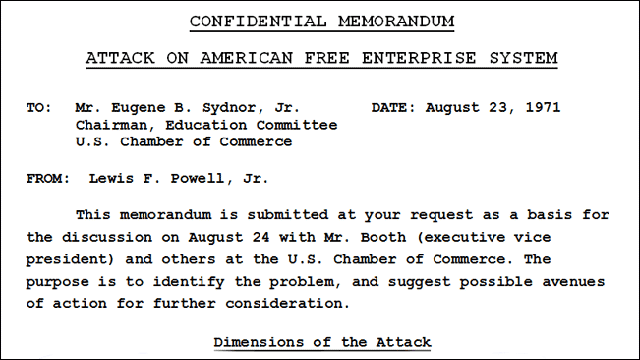
In 1971, future Supreme Court Justice Lewis Powell wrote a confidential memo to the U.S. Chamber of Commerce that would quietly reshape American democracy. The Powell Memo, as it came to be known, was a response to what Powell considered an alarming rise in civic participation during the 1960s and 70s. Civil rights organizers, environmental activists, labor unions, consumer advocates, and antiwar protest movements were challenging corporate power in public. Powell labeled this wave of engagement “excess democracy.” To him, too many ordinary citizens were entering the political arena, threatening the stability of what he called the “free enterprise system.”
Powell’s memo was not a call for moderation. It was a strategic directive. He urged corporate leaders to organize politically with the same intensity that activists used in the streets. He pressed them to fund think tanks, reshape universities, influence media narratives, and expand lobbying networks. His goal was to institutionalize corporate influence so thoroughly that public opinion could be shaped rather than followed. And business leaders listened. In the years that followed, conservative think tanks like Heritage and Cato were born, corporate PAC spending surged, and lobbying in Washington exploded. Elections became increasingly dependent on corporate donors. The shift was gradual, systemic, and deliberate: a political system that once listened to voters began listening to wealth.
Today, the effects are measurable. Multiple academic studies show that the United States operates less as a democracy and more as an oligarchy. One widely cited study by Martin Gilens and Benjamin Page compared nearly 2,000 policy decisions over several decades. Their conclusion was stark: when average citizens disagree with economic elites, the preferences of the average citizen have almost no impact. Policy outcomes overwhelmingly reflect the interests of the wealthy. In other words, the public is heard, but not listened to.
More recent research reinforces the pattern. A 2025 analysis by Shiro Kuriwaki and Stephen Ansolabehere found that Congress aligns with majority public opinion only about half the time. Even widely supported policies often fail—not because of public disagreement, but because of procedural roadblocks like the filibuster, committee bottlenecks, and leadership gatekeeping. Legislation backed by most Americans may never even reach a vote.
The causes are structural. Money in politics gives corporations and wealthy donors disproportionate access to lawmakers. Lobbyists write legislation, shape narratives, and offer future employment to cooperative officials. The candidate pipeline itself filters out those unwilling to serve these interests. Even after winning office, representatives are guided by donor pressure, media influence, and party discipline—not the voices of their constituents.
Powell’s crusade against “excess democracy” was never about safeguarding liberty. It was about reinforcing power. The elite took his memo as a playbook to reassert control over public institutions and maintain influence while preserving the appearance of democratic process. What Powell saw as a threat—ordinary people organizing, participating, challenging authority—is in fact the foundation of a healthy democracy.
America does not suffer from too much democracy. It suffers from too little. The public’s voice has been reduced to background noise in a system tuned to donors instead of voters. Powell’s memo was not a warning. It was a blueprint. And for more than fifty years, the country has followed it—often without realizing it.