The Bus Going Off the Cliff

America has always existed on the edge of contradiction. From its birth, it has been both an idea and an experiment—one that promised unity but was founded on fracture. We were told that liberty could coexist with slavery, that equality could grow alongside hierarchy, that freedom could endure without trust. The miracle of the Republic has been how long those contradictions held. But today, as the seams fray, the old balancing act begins to fail.
Across the political spectrum, Americans sense what their leaders cannot admit: something fundamental is breaking. As the writer Stephen Marche warns, civil wars are not single explosions but “complex cascading systems.” They begin when too many small failures feed one another until the structure collapses under its own contradictions. And the United States, by every measurable factor, fits that description.
It’s not just the polarization, though that’s the most visible. It’s the deeper erosion underneath—the quiet disintegration of trust, meaning, and shared story. Trust in institutions has fallen steadily since 1980: government, media, religion, even local community life. When the Founders designed this system, they warned that it depended not on divine protection but on civic virtue. John Adams wrote that “our Constitution was made only for a moral and religious people. It is wholly inadequate to the government of any other.” Adams wasn’t talking about churchgoing, but about self-restraint, humility, and a shared belief in truth. Remove those, and even the best design fails.
From the outside, the view is terrifying. To many Canadians, as Marche said, America now looks like “a bus going off the cliff—and we’re strapped to the same vehicle.” Once, there was no border. Now, half of Canadians view the U.S. as an adversary. They speak seriously about nuclear deterrence and “whole-society defense.” For the first time in generations, the world is preparing for an America that may no longer be stable or predictable. That fear isn’t anti-American; it’s grief.
Civil wars don’t start with ideology. They start with despair. When citizens lose faith that tomorrow will be better than today, that justice still exists, that words matter more than weapons—then politics becomes war by other means. Violence follows where belief collapses. Samuel Adams once wrote that “the liberties of our country, the freedom of our civil Constitution, are worth defending at all hazards.” His words were about the Revolution, but they apply equally to the moment when a nation must defend itself from within.
Trump is not the disease. He is the symptom—the fever that reveals the infection. That infection began decades ago when the American Dream stopped feeling real. When productivity rose but wages didn’t. When corporations became citizens but citizens felt powerless. When truth itself became negotiable. Alexis de Tocqueville saw the risk early, warning that “the health of a democratic society may be measured by the quality of functions performed by private citizens.” When cynicism replaces civic duty, democracy weakens from the inside out.
Today, America faces what Marche calls a “complex cascading system” of threats: inequality deeper than in 1776; demographic shifts that trigger fear; and hyper-partisanship that corrodes the possibility of dialogue. By 2040, white Americans will no longer be a majority. That milestone should be cause for celebration—the flowering of a truly plural nation—but human psychology rarely follows ideals. Around the world, whenever a dominant group loses its numerical edge, violence follows. Not because of color, but because of fear—the fear of irrelevance, of humiliation, of loss.
Robert Putnam once wrote that diversity, while a long-term strength, can in the short term “reduce social solidarity and social capital.” In plain language, people retreat to their tribes before they learn to trust again. America’s diversity is its superpower, but also its crucible. Every generation must relearn how to live together.
The Founders knew this moment would come. They built checks and balances not because they trusted each other, but precisely because they didn’t. They assumed the republic would require constant renewal—that liberty would survive only if citizens cared more about the whole than about the tribe. James Madison captured this perfectly: “If men were angels, no government would be necessary.” They could not have foreseen Twitter or algorithmic outrage, but they understood human nature. Systems rot when virtue fades.
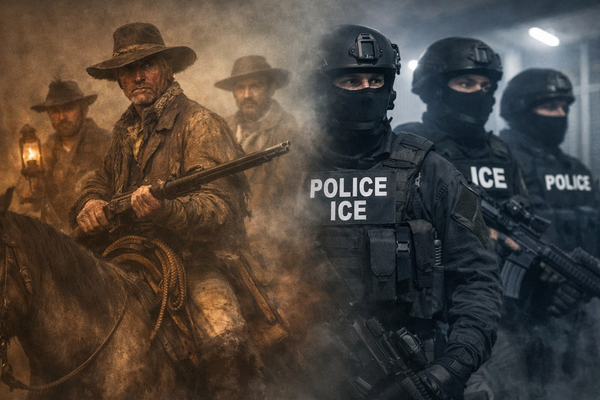
Look closely, and you can already see the shape of a modern civil war. It won’t be blue and gray armies in open fields. It will be asymmetric—a thousand scattered fires: militias, secessions, digital mobs, disinformation, sabotage, and government crackdowns that only fuel more rebellion. Each act of violence will justify the next. The effort to restore order will create the very disorder it seeks to suppress.
And yet, there is still time. All models are wrong, Marche reminds us; some are useful. The point of seeing the danger is not to surrender to it, but to change course. The American experiment was never about perfection—it was about self-correction. Thomas Jefferson wrote, “I tremble for my country when I reflect that God is just; that his justice cannot sleep forever.” Those words were not despair. They were warning—and hope.
Perhaps the bus has not gone over the cliff yet. Perhaps we can still turn the wheel. But that requires seeing the whole system at once: the economic, the cultural, the emotional, the human. It requires confronting how easily fear multiplies and how quickly trust evaporates.
That’s what inspired An Imperfect Union. It’s not just a simulation—it’s a mirror. It lets you see how a divided America behaves when the levers of trade, migration, and ideology shift. You can split the country, set your policies, and watch a decade unfold. It’s not a prediction. It’s a question: what happens when we stop holding the center?
Explore it here and see for yourself what happens when the American experiment breaks apart—and what it might take to hold it together:
https://the-civic-algorithm.ghost.io/an-imperfect-union/