The Classroom as a Battlefield
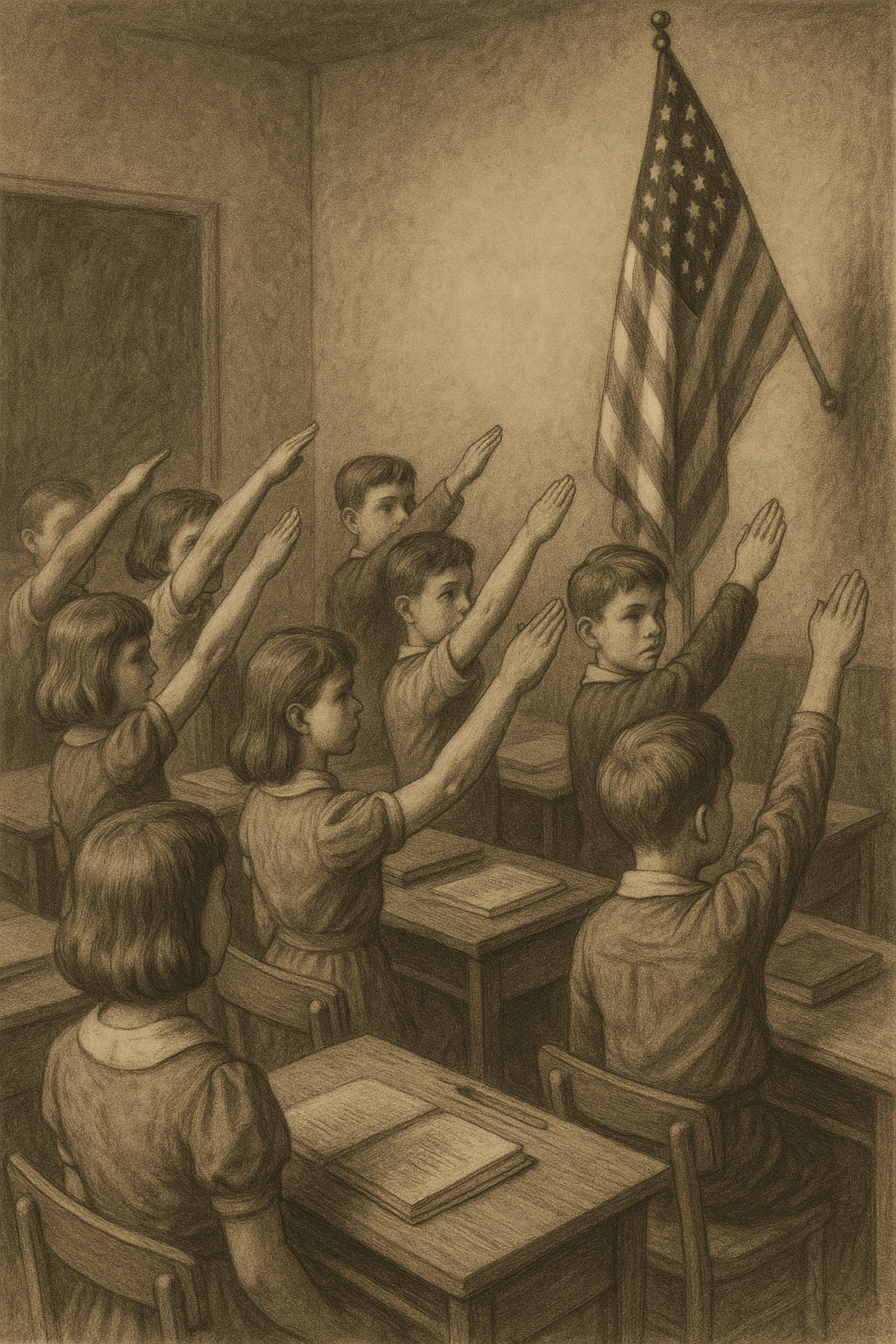
Authoritarians do not fear the ballot box. They fear the classroom. A population taught to think critically is a population that can resist. A population taught to ask why is a population that cannot be easily controlled. This is why Hitler went for the schools long before he consolidated every other institution of German life. The Nazi project did not begin with genocide. It began with curriculum.
Hitler said it plainly: “He alone, who owns the youth, gains the future.” That was the blueprint. Public education in Weimar Germany had been one of the most progressive and humanistic systems in Europe. It taught philosophy, literature, and the idea that citizenship meant thinking for oneself. To Hitler, that was a threat. So the very first target was the independence of teachers. Jewish educators were dismissed; educators who believed in democracy were purged; every remaining teacher was required to join the National Socialist Teachers League and swear an oath not to truth, not to knowledge — but to Hitler personally.
Curriculum was rewritten from the ground up. History was recast not as a record of human struggle, but as a racial destiny narrative in which Germans were chosen, superior, and besieged. Biology was turned into propaganda for racial pseudoscience. Even mathematics textbooks were rewritten to include word problems about “enemies of the state.” Education was no longer about learning — it was about conditioning. Hitler wrote that the purpose of schooling was “to create disciplined, physically strong, obedient youth who will not question orders later in life.” The classroom became a pre-military training ground. The Hitler Youth finished the work that textbooks began.
The goal was not just to teach children what to think — it was to destroy their instinct to question. Because a child who asks questions becomes an adult who recognizes manipulation. The Nazi regime understood this so deeply that they redesigned childhood itself.
This pattern is not distant history. We are watching its early forms now.
Donald Trump has repeatedly framed public education not as a civic institution but as enemy territory. He has declared that schools are “indoctrinating our children,” that educators are “poisoning young minds,” and that history lessons about racism are “mentally abusive.” He has promised, directly and repeatedly, “I will close the Department of Education” and “We will stop the radical indoctrination of our youth.” His first executive actions in his new term targeted curriculum, ordering schools to eliminate what he calls “un-American ideology” — a phrase chillingly close to the language the Nazis used when they accused public schools of spreading “degenerate ideas.”
Book bans follow the same logic. The Nazis held book burnings to eradicate the “ideas that weaken the Volk.” Today, public schools in the United States are banning books for teaching the existence of racism, for acknowledging queer people exist, for telling history as it was lived instead of as some would like to remember it. The targets are always the same: Black history, LGBTQ+ literature, anti-fascist resistance movements, labor history — anything that teaches the public to recognize patterns of oppression.
Hitler said, “We must teach the child nothing which might cause him to ever think differently from us.”
Trump asked a crowd, “What they’re teaching in schools now, can you believe it? They’re teaching kids to question America.”
The phrasing changes. The project does not.
When Trump threatens universities with funding cuts for allowing protests, he echoes the Nazi principle that education must not produce dissent. When he tells parents that teachers are the enemy, he mirrors the Nazi strategy of separating the child from the broader civic community and fusing loyalty to the leader instead. When his allies push “patriotic education,” they are resurrecting the exact model Hitler used — history as mythology, nationalism as morality, obedience as virtue.
And the goal is the same: eliminate the ability to recognize authority as something that can be challenged.
The danger is not that we will wake up one morning and find ourselves in 1933. The danger is that we will fail to notice the slow, quiet shift — from education as liberation to education as compliance. From school as public good to school as ideological gatehouse. From the classroom as a place where children learn how to see the world — to a place where they are told not to look at it too closely.
History does not repeat. It teaches.
The question is whether we are willing to learn.
Hitler believed that if you control what a child reads, hears, and is allowed to question, you can shape a nation without firing a shot. Trump is not Hitler. America is not 1930s Germany. But the strategy — the understanding of where power lives and how it is passed down — is the same.
If we lose public education as a place of inquiry and truth, we lose the foundation of democracy itself. Because a country that cannot think will kneel. And a child taught not to question grows into an adult who doesn't know how.
This fight is not about schools.
It is about the future of the ability to think.
And that is always the first battlefield.