The Founders and the Faith Invented in Their Name
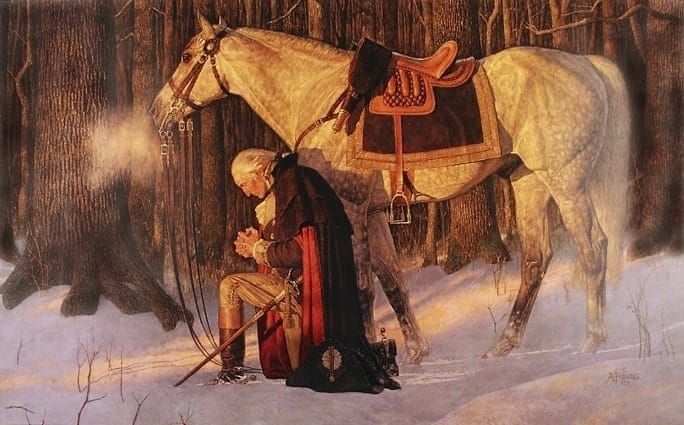
One of the most iconic images used by white Christian nationalists is the famous painting of George Washington kneeling in the snow at Valley Forge, praying for divine salvation. It is stirring and cinematic—Washington as a humble servant of God, asking heaven to bless the birth of the United States. It is also a myth. The scene never happened.
The story first appears not during Washington’s lifetime, nor in any eyewitness account, but in an 1800 biography by Mason Locke Weems—better known as “Parson Weems.” Weems was the same writer who invented the cherry tree story, claiming Washington said, “I cannot tell a lie.” His goal was not to document history, but to create moral parables that made Washington into a Christian saint. He provided no source, no testimony, no letters, no verification. He simply wrote it because it made a good story.
The image we now know came later, in 1855, when artist Henry Brueckner painted George Washington Praying at Valley Forge. It was commissioned during a period of intense evangelical revivalism in America, when churches and political groups were actively trying to frame the United States as a holy Christian nation. The painting spread because it served a purpose. It created a sacred origin story.
But the real Washington did not behave this way. He was deeply reserved about religion. In his letters and speeches, he referred to God in broad, deist terms: “Providence,” “the Great Author,” “the Supreme Dispenser of Events.” He avoided taking communion, frequently left church early before the sacrament, and did not publicly express belief in Christ’s divinity. Late in life he wrote, “I have ever deemed it my duty to respect all religions, and confine myself to none.” He believed faith was a private matter of conscience—not something to be performed, imposed, or used to bind the nation.
This is not the Washington of the painting. And that is the point. The Washington who actually existed would have opposed the very movement that now claims his image.
The same pattern holds with the other Founders. Thomas Jefferson cut the miracles out of his Bible because he believed clergy had corrupted Christianity. Benjamin Franklin wrote, “I have found Christian dogma unintelligible,” yet believed in a Creator who encouraged moral living. John Adams, who was far more devout than either of them, nevertheless affirmed in the Treaty of Tripoli that “The government of the United States is not, in any sense, founded on the Christian religion.” These were not men building a religious state. They were building a state strong enough to prevent one.
They had come out of Europe, where religion and government had been fused for centuries—with disastrous consequences: inquisitions, forced conversions, excommunications, state-backed punishments, and holy wars. They knew that when government claims to speak with the authority of God, all disagreement becomes heresy, and heresy becomes treason. A nation founded on pluralism collapses under that logic.
White Christian nationalism rejects this entire legacy. It claims America belongs to Christianity, that its laws must reflect one theology, and that political opponents are not just wrong but ungodly. It uses religion not as a guide for compassion or humility, but as a cultural badge of dominance. It replaces the cross with the flag and calls the fusion sacred.
That is not Christianity. That is not patriotism. It is nationalism wearing a borrowed halo.
The Founders were not perfect men. But they understood something profound: the moment one faith claims ownership of the nation, both the faith and the nation are corrupted. Washington did not kneel in the snow to bless America as Christian. He built a country where no one has to kneel at all. That was the point. That was the promise. And that is what we are now being asked to forget.