The Fracture Between Image and Reality in America’s Authoritarian Drift

There is a growing distance between the image the current administration insists on projecting and the reality unfolding beneath it. The official narrative claims strength, stability, and the restoration of order. But the pushback from journalists, civic institutions, and ordinary citizens is telling a different story: one of a government struggling to maintain control over a narrative that is slipping away.
Political commentators often treat history like a competition — who is up, who is down, what the next move will be. But historians look for deeper currents: the structural forces that bend societies, break them, and transform them. From that vantage point, what we are witnessing is not stability under firm leadership, but the slow unraveling of a movement that has relied for decades not on majority support, but on structural manipulation.
The modern ideological identity of the Republican Party, shaped significantly since the 1980s, has long been out of step with the majority of Americans. Party strategists in that era understood this. Their solution was not to persuade the public, but to engineer the system. They sought to lock in power by reshaping the courts, redrawing electoral maps, suppressing votes, and cultivating a media ecosystem that blurred truth with propaganda. These were not temporary tactics; they were designed to make political dominance independent of popular will.
Today’s imbalance between public sentiment and political power is the direct result of these decades-long efforts. States such as North Carolina, where one party can win statewide elections yet lose legislative control due to district manipulation, reveal how representation has been decoupled from democracy. The weakening of the Voting Rights Act only accelerated this trend. And yet, when civic participation drops or public trust erodes, pundits still blame “apathy,” rather than acknowledging the deliberate obstacles placed in citizens’ path.
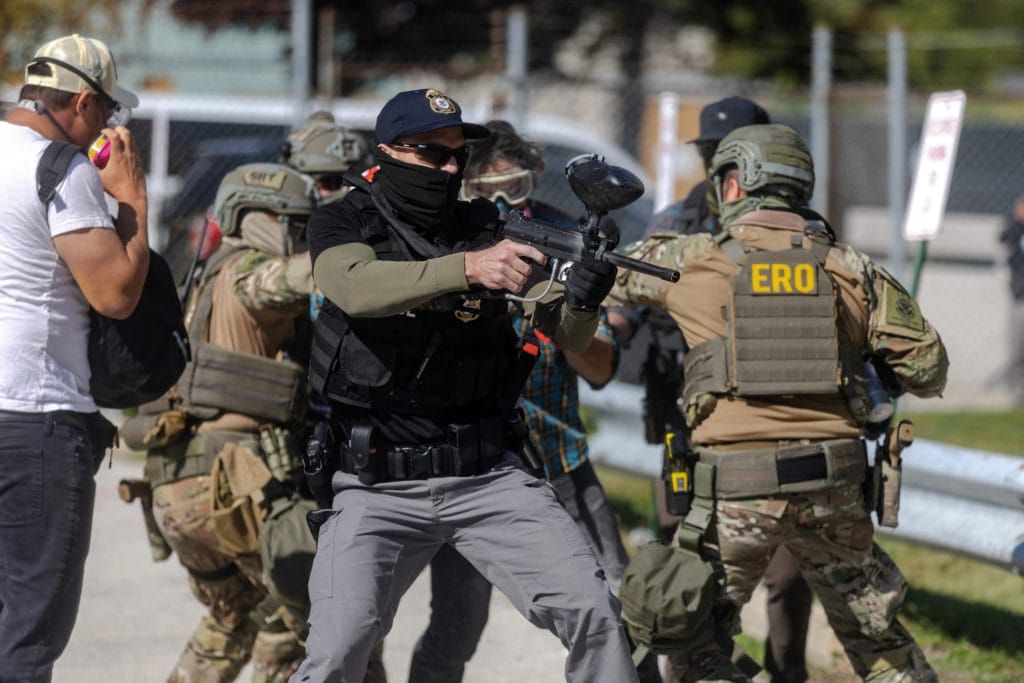
This structural advantage underpins the administration’s projected image of confidence and control. It presents cities as war zones, undocumented immigrants as existential threats, and political dissent as disloyalty. The state becomes a stage on which fear is choreographed and amplified. Each press conference, raid, and heavily produced video is designed not merely to inform, but to intimidate — to create the illusion of decisive power confronting chaos.
But the illusion is cracking — most clearly in the data about who is actually being detained by U.S. Immigration and Customs Enforcement. Independent research consistently shows that the majority of people held in ICE detention have no criminal convictions at all. In multiple nationwide snapshots from 2024 and 2025, between 65% and 72% of people in ICE custody had no criminal record, and among those who did, fewer than 7% had convictions classified as violent. These figures undermine the central justification for the spectacle of raids and mass detentions. The data reveals that the performance of “protecting the public” is less about safety and more about political theater.
Once the public sees that the so-called threat is largely imaginary — that the majority of detainees are ordinary people rather than dangerous criminals — the entire performance begins to lose coherence. And that is precisely what is happening. Citizens are mocking the propaganda. Independent journalists are documenting the gaps between claim and fact. Civic institutions are beginning, however cautiously, to refuse complicity. News outlets have rejected gag orders. Universities have declined funding tied to ideological loyalty. Public facilities have refused to display partisan messaging disguised as public service announcements.
Individually, these acts of defiance may seem small. Historically, they are not. They mark the point when imposed narratives fail to fully colonize public reality — when coercion starts hitting the natural limits of consent.
The historian’s perspective reminds us that authoritarian projects do not collapse in a single dramatic moment. They erode when the distance between what people are told and what they experience becomes too large to ignore. They falter when fear stops being believable. They weaken when ordinary people cease to internalize the spectacle.
Reclaiming democracy will not be easy. The architecture of minority rule is deeply embedded, and the habits of resignation and exhaustion even deeper. But democracy has always depended on the same core principle: that ordinary people, given voice and agency, can govern themselves. The struggle has always been between concentrated power and the collective wisdom of the many.
Right now, the façade is cracking. The narrative is weakening. The public is beginning to see through the performance. And history, once again, is shifting under our feet.