The Fusion of Faith, Power, and Fear

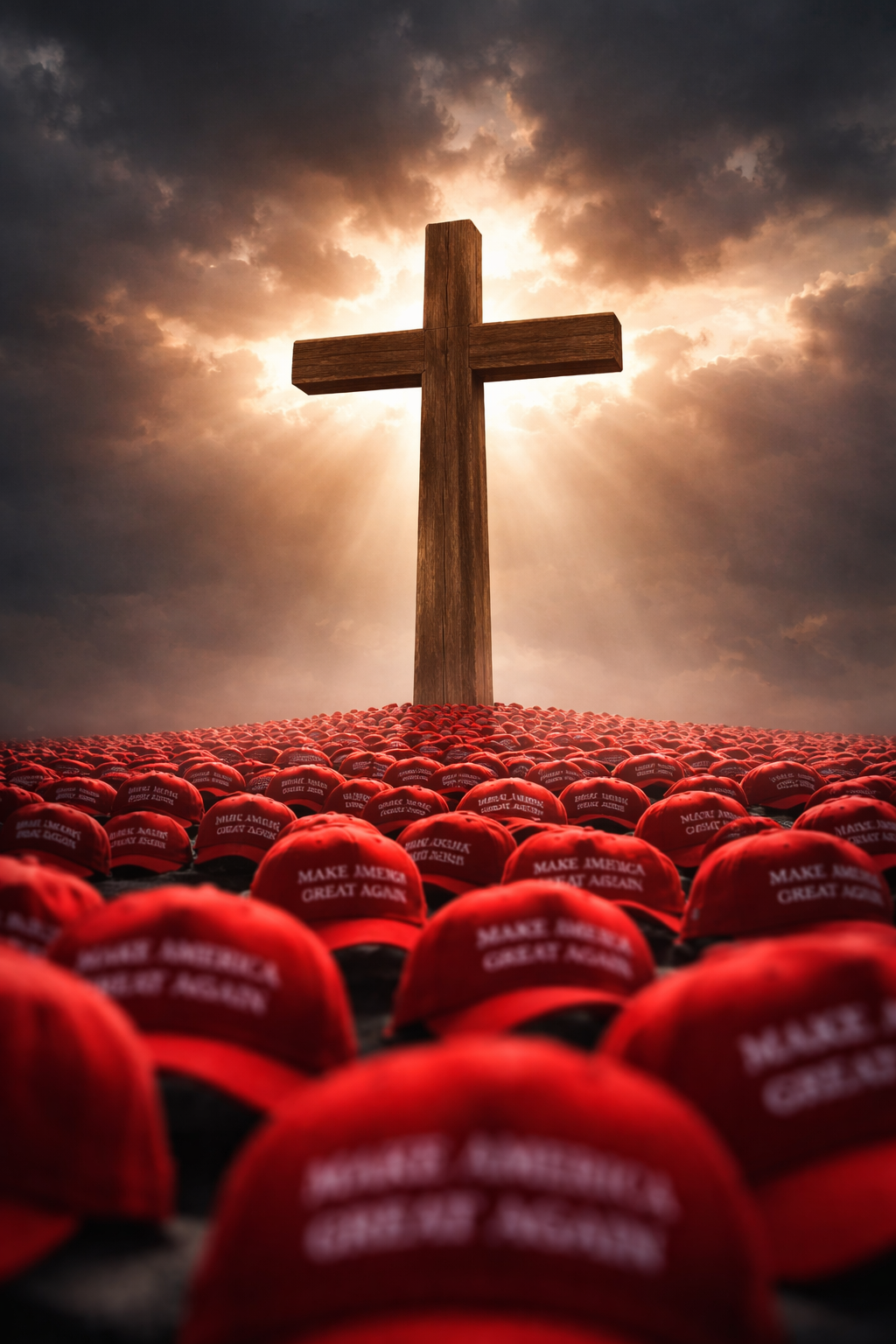
The tight bond between American evangelicalism and MAGA did not appear suddenly, nor did it arise from theology alone. It emerged from a long process in which religious identity, racial hierarchy, and partisan power gradually fused into a single moral and political worldview. To understand why so many white evangelicals now treat Republican politics, and particularly Trumpism, as an extension of faith itself, it is necessary to see how cultural anxiety, racial power, and apocalyptic belief reinforced one another over generations until politics became the arena where religious meaning was finally secured.
American Christianity has always existed in tension with power, but it has never been separate from it. From the nineteenth century onward, white Protestant institutions were deeply embedded in the social order that governed who belonged, who ruled, and who obeyed. This was not abstract. The largest evangelical body in the country, the Southern Baptist Convention, was created explicitly to defend slavery, splitting from northern Baptists who opposed it. After emancipation, segregation and racial hierarchy were not theological afterthoughts but lived realities, reinforced through church networks, private schools, and local authority. Faith became a stabilizing force for a world that assumed white dominance as normal and divinely permitted.
The early twentieth century introduced a new threat to that order. Modernist theology and the social gospel challenged biblical literalism and argued that Christianity required structural reform, not just personal salvation. Fundamentalists rejected this, insisting that the world was fallen and nearing judgment and that efforts to reshape society were distractions from saving souls. This theological posture dovetailed neatly with resistance to federal reform. When Franklin Roosevelt expanded the state through the New Deal, many fundamentalists did not simply object to policy. They interpreted it as moral decay, spiritual corruption, and even satanic influence. The habit of reading politics as a cosmic struggle took root early.
The Cold War intensified this worldview. Communism was cast as a rival religion, godless and hostile to evangelism, threatening both American power and Christian missions. Anti-communism gave evangelicals a language that combined nationalism, faith, and fear into a single narrative. At the same time, the civil rights movement forced a reckoning that many white evangelicals tried to avoid. Federal enforcement of desegregation struck at the heart of local control, private Christian schools, and the racial homogeneity of congregations. Resistance was often framed as opposition to government overreach or defense of religious liberty, but the material stakes were racial. The loss being mourned was not merely freedom of worship. It was the erosion of a social order in which whiteness and authority were aligned.
As segregation became publicly indefensible, the political language shifted. Abortion emerged as a moral focal point in the 1970s, not initially because it was universally central to evangelical theology, but because it could unify disparate grievances under a single, emotionally absolute cause. Opposition to abortion allowed white evangelicals to mobilize politically without naming race while still resisting broader cultural changes around gender, sexuality, and authority. It also enabled alliance with conservative Catholics and offered a clear moral litmus test that could override all other concerns. Once abortion became the hinge, politics no longer required consistency of character. It required loyalty to outcomes.
The Reagan era proved the durability of this bargain. Evangelicals delivered votes, organization, and moral rhetoric. Republicans delivered access, symbolism, and judicial promises. Even when legislative victories fell short, the sense of being under siege kept the alliance intact. Cultural change accelerated, women entered the workforce in larger numbers, LGBTQ people gained visibility and rights, immigration diversified communities, and religious pluralism became unavoidable. Each shift reinforced the perception that America was slipping away from its rightful owners. Faith increasingly functioned not as a moral compass but as a boundary marker, defining who belonged inside the nation’s story and who did not.
By the time Trump arrived, the groundwork was complete. He did not persuade evangelicals by embodying Christian virtue. He succeeded by embodying their accumulated fears and resentments with ruthless clarity. He spoke the language of domination, grievance, and restoration. He promised protection from demographic change, humiliation of enemies, and the aggressive use of state power against perceived threats. For a movement already accustomed to apocalyptic thinking, he fit easily into the role of the flawed but chosen instrument. Moral dissonance was resolved through necessity. If the nation was at risk, then normal ethical standards could be suspended in the name of survival.
Race remained central, even when unnamed. Immigration, policing, voting laws, and urban unrest were framed as civilizational threats rather than policy questions. Appeals to “law and order” echoed earlier defenses of segregation. Claims of election fraud resonated because they aligned with a deeper belief that legitimate power should not change hands to those outside the traditional hierarchy. Christianity, patriotism, and whiteness blurred into a single identity, defended not through persuasion but through suspicion and force.
In recent years, strands of charismatic and prophetic Christianity have amplified this fusion, casting political conflict as spiritual warfare and leaders as divinely anointed. These movements did not create evangelical authoritarianism, but they intensified its emotional charge. They supplied certainty in an uncertain world and transformed compromise into betrayal. The result is what scholars now describe as Christian nationalism, a belief that the United States is inherently Christian and must be governed accordingly. This belief is not about personal faith. It is about control, memory, and power.
The cost of this fusion has been severe. It has hollowed out Christian moral witness by subordinating virtue to victory. It has weakened democratic norms by treating opponents as enemies of God rather than fellow citizens. It has accelerated religious disaffiliation among younger generations who see faith wielded as a weapon rather than a call to humility and care. History offers a clear warning here. When religion binds itself too tightly to political power, it does not sanctify the state. It corrupts the faith.
The intertwining of evangelicalism and MAGA is not an aberration. It is the culmination of a long pattern in which fear of loss, especially racial and cultural loss, was managed through theology and then converted into politics. Understanding that history does not require hostility toward Christianity. It requires honesty about how easily faith can be bent to serve domination and how dangerous it becomes when belief is used not to restrain power but to justify it.