The Long War Against the Voting Rights Act
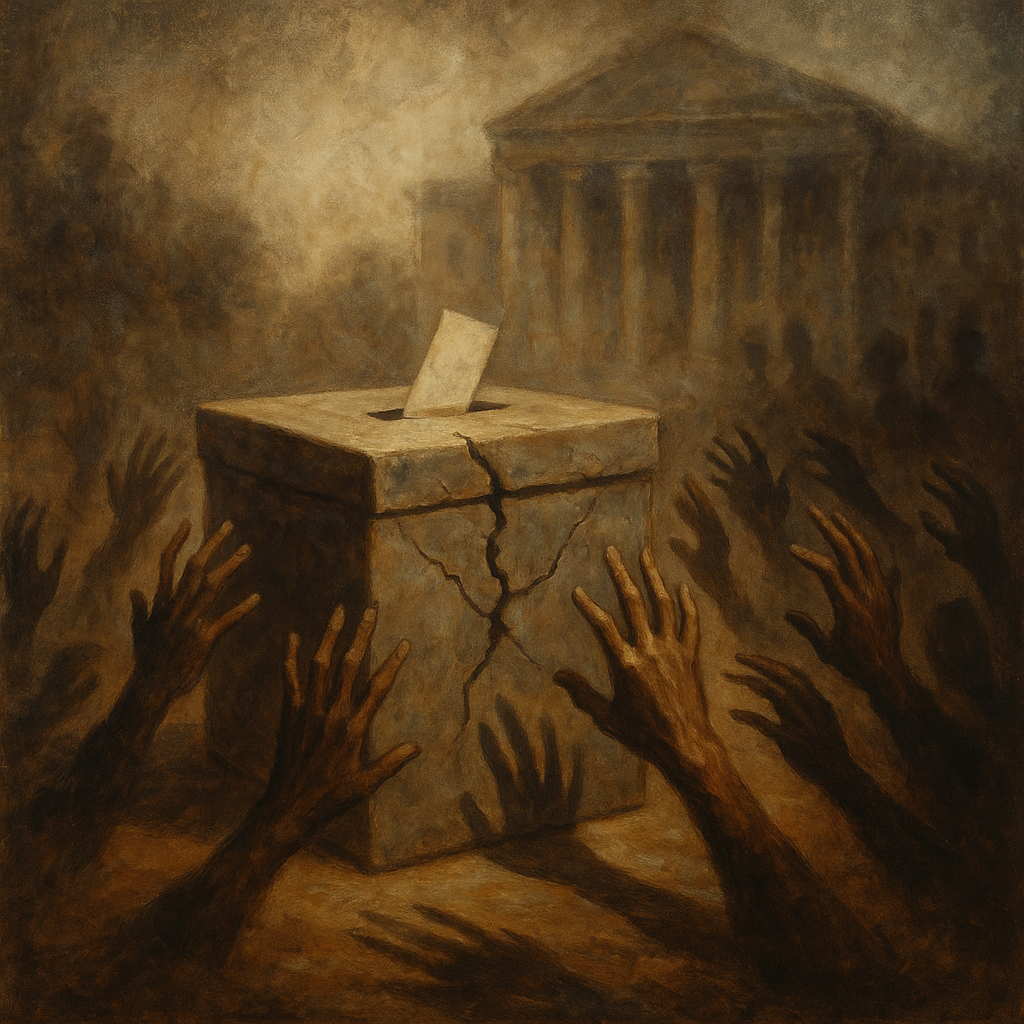
The Voting Rights Act was not simply a law about elections. It was an attempt to finish the unfinished work of Reconstruction. After the Civil War, the 13th, 14th, and 15th Amendments abolished slavery, guaranteed equal protection under law, and prohibited denying the vote on account of race. On paper, the United States had recognized that freedom required political participation. Frederick Douglass famously stated, “Slavery is not abolished until the Black man has the ballot.” But almost immediately, white southern lawmakers and vigilante organizations worked to nullify those guarantees. Through terror, poll taxes, literacy tests, grandfather clauses, and political violence, Black political participation was nearly erased. The Supreme Court, instead of intervening, often ratified these systems or stood aside entirely. The Constitution’s promise existed, but the state chose not to enforce it.
The Voting Rights Act of 1965 was written to force enforcement. President Lyndon Johnson, in his address introducing the Act, said, “Their cause must be our cause too, because it is not just Negroes, but really it is all of us.” He understood that American democracy could not claim legitimacy while excluding millions of its citizens. The Act did two essential things. First, it created federal oversight in jurisdictions with histories of racial suppression; those areas could not change voting rules without federal approval. This prevented discrimination before it happened. Second, the Act created mechanisms for challenging discriminatory voting rules and political maps nationwide. The result was immediate. By the late 1960s, Black voter registration in places like Mississippi rose from single digits to over half of eligible adults. For the first time since Reconstruction, Black voters could meaningfully shape political representation in their own communities.
But the Voting Rights Act confronted a recurring problem: discrimination adapts. After explicit barriers were struck down, officials turned to structural barriers. One of the most significant was the drawing of electoral districts to dilute minority voting power. If white majorities voted together and districts were drawn across racial lines, they could effectively guarantee that minority voters would never elect their preferred candidates. The Supreme Court recognized this in the 1980s and held that where minority voters are large enough and politically cohesive, and where they are consistently defeated by bloc voting, states must draw districts that give them a real chance to elect representatives. Thurgood Marshall expressed the principle behind this clearly: “Where you see wrong or inequality or injustice, speak out, because this is your country.” The purpose was not to advantage one group over another. It was to prevent a permanent political caste system.
Over the past decade, the Supreme Court has begun dismantling the Voting Rights Act. In 2013, the Court effectively nullified federal oversight provisions by arguing that conditions had improved enough that special monitoring was no longer needed. Within hours, states moved to pass new voting restrictions. In 2019, the Court ruled that federal courts could not stop partisan gerrymandering, even though in many states race and party are deeply intertwined. In 2021, the Court made it far harder to challenge voting rules that disproportionately harm minority voters. And today, the Court is hearing cases that may weaken Section 2 of the Act itself, either by redefining how discrimination is proven or by eliminating the ability of private citizens to bring cases at all. If only the federal government can sue, and it chooses not to, the law will remain on the books but will not function.
This moment matters because democracy is not simply about having elections. It is about whether those elections translate public will into public power. The stakes go far beyond Congress. State legislatures, city councils, county commissions, and school boards are all shaped by how districts are drawn and whose votes carry weight. These bodies determine access to clean water, school funding, policing priorities, healthcare infrastructure, and environmental protections. When voting power is diluted, so too is the ability of communities to shape the conditions of their own lives.
The larger question is whether the United States will remain a multiracial democracy in practice, not just in rhetoric. The Voting Rights Act was designed to prevent the predictable: that a majority could rule in ways that permanently entrench itself, excluding other groups from meaningful power. We are now living through another period of renegotiation. The law is being questioned, weakened, and reinterpreted. But history suggests that progress has never been linear. When women were denied the vote in the 1870s, it took fifty years of organizing and state-level reform before the Constitution was amended. When Reconstruction collapsed, it took nearly a century of activism before the Voting Rights Act was born.
The right to vote has never been given freely. It has only ever been won, defended, and won again. The question is not simply what the Supreme Court will do, but what the public is willing to insist upon. A democracy survives only when the people who are excluded refuse to accept exclusion as inevitable. The Voting Rights Act exists because people believed democracy required not just the right to vote, but the real power to be heard. If that belief remains, the work continues.