The Narcotic of Nationalism: How American Historians Keep America Addicted to Its Own Myth
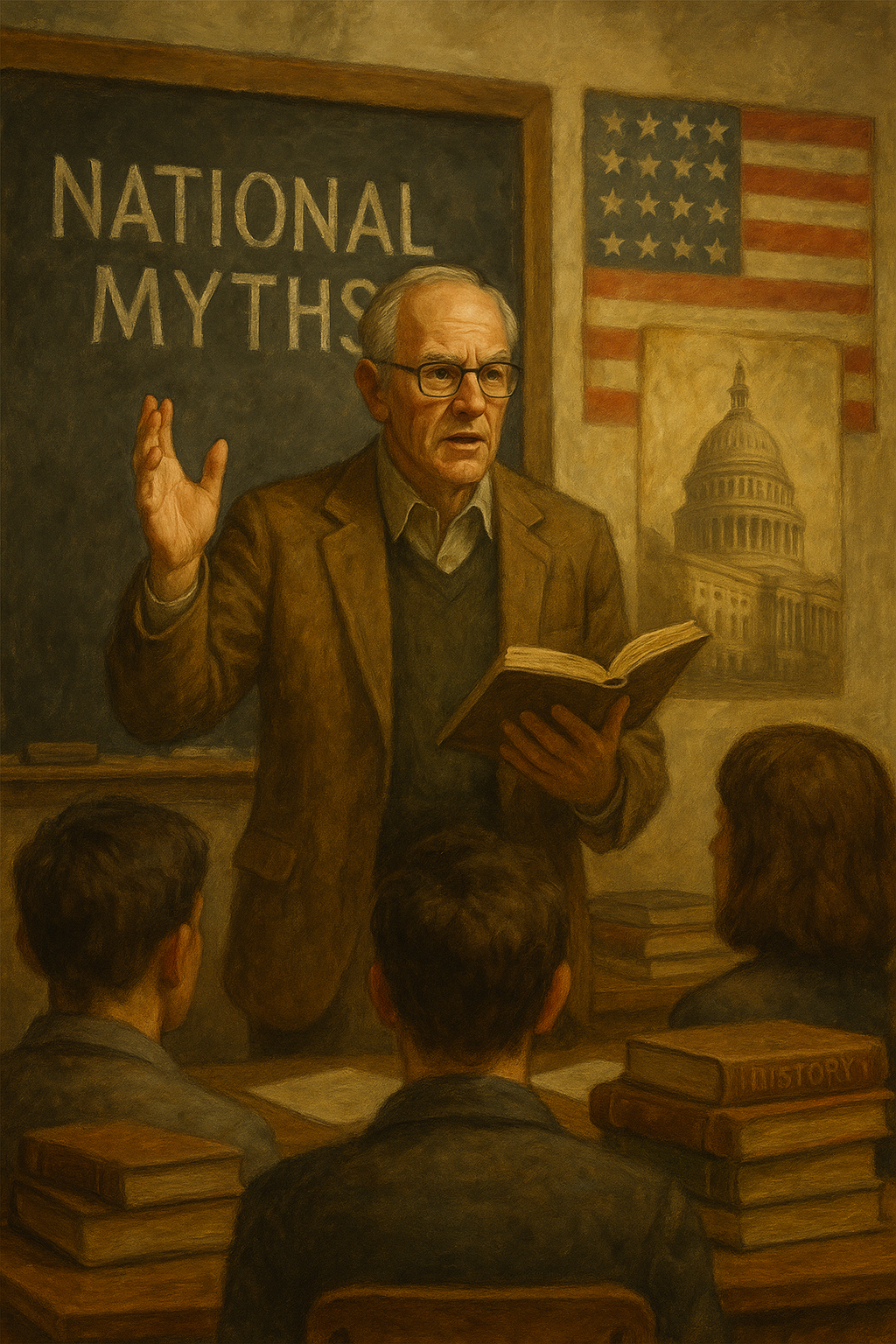
Let’s talk about a problem that sits at the core of how Americans understand history, and how many of our own historians continue to make that problem worse. Eric Hobsbawm once said that “historians are to nationalism what poppy growers are to heroin addicts.” It’s a devastating line — and no nation proves it truer than the United States.
The problem is structural, not accidental. America was born in the same intellectual moment that produced nationalism itself. The 18th century, from Rousseau to Hegel, was the crucible where the modern idea of the nation-state took form. The United States wasn’t a product apart from that development — it was the embodiment of it. Nationalism and the American project matured together, bound from the beginning by the same logic: that a people could define themselves through a shared myth of origin, divine purpose, and destiny. That logic became the bedrock of American education, politics, and the way we write and teach history.
A national framework isn’t evil, but it is limiting. It makes America the center of the story, treating everything else as background. That’s why colonial history in American classrooms is usually just a prequel — a build-up to the “main event.” The colonies that became the United States are cast as the protagonists, while other parts of the Atlantic world — Nova Scotia, Jamaica, Quebec, the Bahamas, even Florida — vanish from the picture. They don’t fit the narrative arc that ends with 1776 and the birth of the chosen republic.
This is what historians call teleology: telling history backward, defining the past by the endpoint you already know. It’s the logic of destiny rather than discovery. The Revolution becomes inevitable. The Constitution becomes divine. The United States becomes the natural and moral outcome of history itself. Anything that doesn’t serve that story — Indigenous societies, enslaved Africans, competing European empires, even internal divisions among colonists — gets stripped away. What remains is a sleek, moralized narrative: America was always coming, and it was always good.
That’s how the Revolution, the War for Independence, and the Constitution have all been merged into a single mythic tale. John Adams, who lived through all three, was furious about this even in his own time. He reminded readers that these were distinct events with different people, motives, and consequences. The Revolution was a social upheaval. The war was a brutal, contingent conflict. The Constitution was a political experiment — one not guaranteed to succeed. Yet, in popular retelling, they merge into one continuous story of virtue, courage, and destiny. From Hamilton to Ken Burns, we get one seamless morality play where the United States is the hero that always triumphs.
Once you crown the nation as protagonist, everything else becomes the story of its rise — the westward expansion, the Civil War, industrialization, the march toward global hegemony. The history of the United States becomes the history of the world, told through the eyes of white Europeans and their descendants. Everyone else — Black Americans, Native peoples, immigrants, women, and the colonized — are supporting characters at best, obstacles at worst. The result is a distortion so powerful that it feels invisible. It’s not just bad history; it’s bad philosophy.
The deeper problem, though, isn’t the national frame. It’s the nationalist faith. Nationalism is not the same as patriotism. Patriotism is love of country — the desire to see it improve, to live up to its ideals. Nationalism is belief in the country as chosen — exceptional, pure, divinely favored, a moral compass for the world. Patriotism humbles; nationalism sanctifies.
That sanctification began with George Bancroft, the 19th-century historian who essentially wrote the first “official” American story. Bancroft’s work was an open hymn to divine purpose. He described the American founding as an act of Providence — a chosen people establishing liberty for the world. That framing hardened into a cultural reflex, passed from one generation of historians to the next, reinforced by war, media, and education. By the 20th century, this mythology had become the backbone of both our politics and our entertainment.
Victor Davis Hanson is a perfect modern example of this. His writing on ancient Greece and “Western civilization” isn’t really about Greece or the West at all — it’s about constructing a moral genealogy that ends with America. He recasts every battle, from Marathon to Normandy, as part of a single civilizational struggle for “Western virtue.” The message is always the same: America is the heir to all that was noble, disciplined, and brave in history. It’s nationalism disguised as scholarship, and it’s popular precisely because it flatters the reader into believing they belong to something ancient, righteous, and preordained.
You can hear that same theology in our everyday political language. “The American experiment.” “America’s original sin.” “A city on a hill.” These are not historical categories; they’re religious ones. The story goes that God made America perfect, that slavery was a corruption from outside, and that the Civil War served as an act of national redemption. Once purified, the republic resumes its sacred mission toward a “more perfect union.” It’s a catechism, not a chronology.
American historians — wittingly or not — have become the clergy of this civic religion. They interpret the scriptures of the Founders, reciting passages from Jefferson, Madison, and Hamilton as if they were divinely inspired texts. They are asked not what history reveals but what Washington would have thought. They act as intermediaries between the public and the myth, reassuring us that, despite our flaws, the story bends inevitably toward justice and freedom. Even critics on the left, invoking the Constitution or the “original ideals of the republic,” remain trapped within the same sacred narrative. They can challenge the content, but not the creed.
The result is paralysis. When both sides of the political spectrum agree that America is the world’s moral center — one side defending it, the other trying to redeem it — there’s no room left for real critique. The imagination becomes nationalized. The historian becomes a priest.
Breaking that spell doesn’t mean abandoning America or adopting some globalist ideology. It means seeing the United States as one thread in a much larger fabric — the Atlantic world, the global economy, the shared human story. It means understanding that the Enlightenment ideals of liberty, reason, and democracy were never uniquely American, but global experiments with uneven results. It means recognizing that history is not destiny.
Until we can separate history from theology, we’ll keep mistaking myth for meaning. The United States is not the end point of civilization. It’s an episode — remarkable, flawed, contingent, and fragile. The most patriotic act a historian can perform is to tell that truth plainly. Because the greatest myth ever told isn’t that America is free. It’s that America was inevitable.