The National Voter File and the Quiet Architecture of One-Party Rule

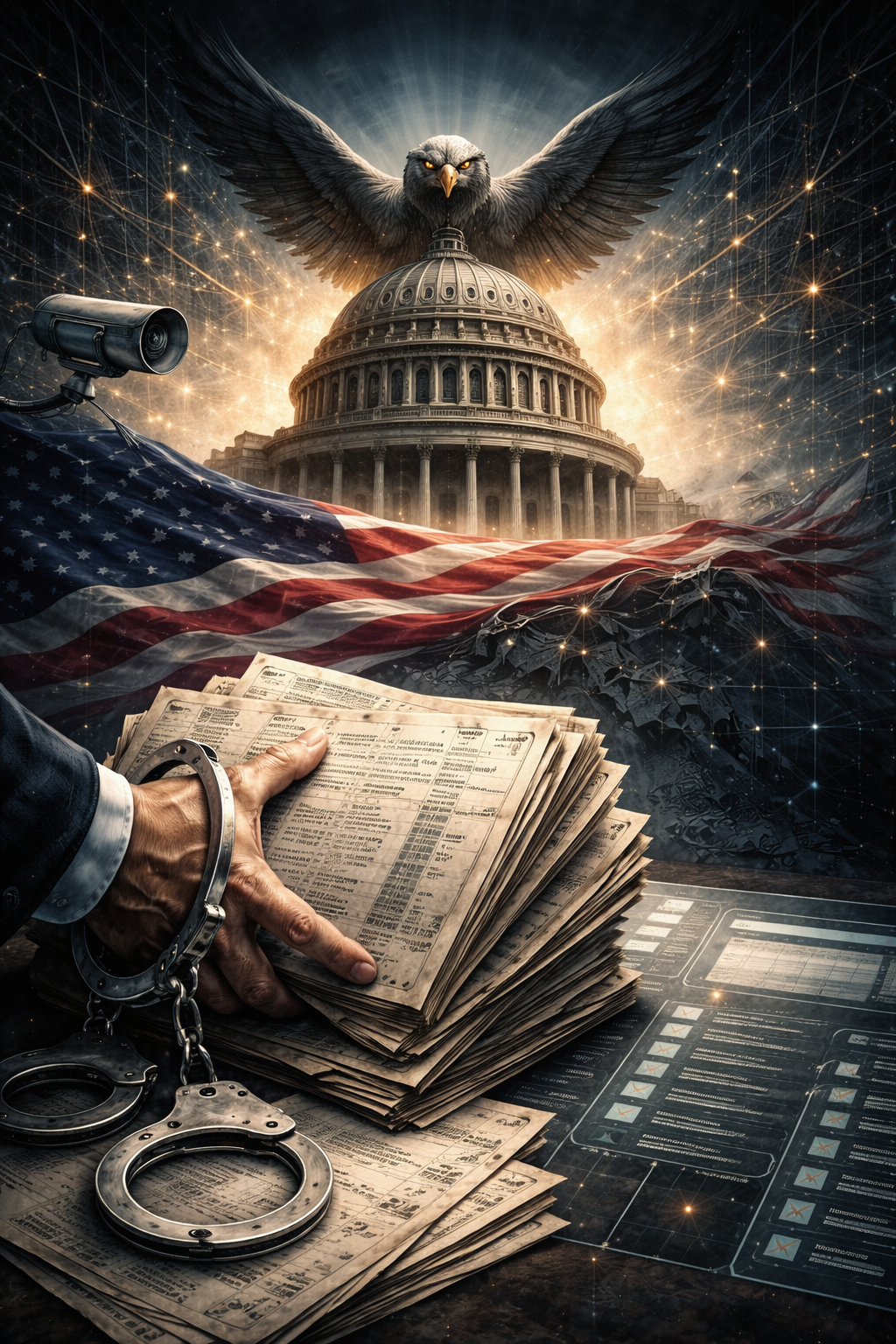
Gerrymandering is the blunt instrument. It is visible, litigated, and familiar. What is less visible, and potentially more consequential over time, is the attempt to centralize and weaponize the administrative substrate of voting itself. The Trump administration’s Justice Department has been suing states across the country to compel access to complete statewide voter registration databases, including sensitive personal fields that many states treat as confidential. The scope is not marginal. The effort now spans a large number of states and local jurisdictions, with federal lawyers arguing that existing election law grants the attorney general broad authority to obtain these records.
To understand the danger, voter rolls have to be treated as what they really are. Not just lists, but a distributed identity system that determines who is allowed to participate in the political system in practice. A modern state voter file contains far more than names and party affiliation. The records being sought include full names, residential addresses, dates of birth, driver’s license numbers, partial Social Security numbers, registration history, and administrative status fields that determine whether a voter is active, inactive, or subject to removal. This is not neutral information. It is a high-value dataset that can be merged, scored, flagged, and operationalized.
The first danger is structural. Centralization alters the balance of power between states and the federal executive. Elections in the United States are administered through state systems precisely because dispersion limits capture. When the federal government asserts the right to aggregate voter data nationwide, it creates a single point of leverage. Even if framed as oversight or compliance, the practical effect is to give the executive branch the ability to pressure states through litigation, dictate standards, and punish resistance. Lawsuits themselves become a governing tool. Compliance is extracted not through persuasion, but through exhaustion. The result is not uniform integrity but federal dominance over election administration.
The second danger is functional. Once granular voter data is centralized, eligibility becomes an enforcement problem rather than a civic status. Voter rolls can be cross-referenced with immigration databases, criminal justice systems, and other federal records. This has already begun. The logic of enforcement systems is fundamentally different from the logic of democratic participation. Enforcement assumes suspicion, prioritizes false positives over false negatives, and tolerates collateral damage as an acceptable cost. When that logic is imported into voting, errors do not register as errors. They register as purges, delays, additional documentation demands, and provisional ballots that quietly disappear.
The third danger is bureaucratic, and it is where disenfranchisement most often hides. Database matching is imperfect. Names collide. Birthdates are mistyped. People move. Naturalized citizens are misclassified. When these mismatches occur inside administrative systems, there is no courtroom drama. There is no public reckoning. A voter simply arrives at the polls to discover a problem they did not know existed, or never receives a ballot they were entitled to receive. The burden of correction falls entirely on the individual, often under tight deadlines and opaque rules. This friction does not fall evenly. It concentrates on people who move frequently, lack stable documentation, or already have reason to distrust government institutions.
The fourth danger is political without needing to be explicit. A Justice Department that controls access to voter data, decides where to sue, and determines how aggressively to enforce ambiguous standards becomes a partisan instrument even if it never announces itself as such. Enforcement can be geographically selective, focusing on jurisdictions that vote the “wrong” way. It can be demographically selective through proxies embedded in data, such as mobility patterns or neighborhood characteristics. It can be timed to coincide with registration deadlines or election administration bottlenecks. None of this requires an order saying, “Stop these voters.” It only requires discretion, incentives, and silence.
The fifth danger is psychological. When voters believe that registering, updating an address, or requesting a ballot feeds information into a federal enforcement pipeline, participation declines. The chilling effect does not require mass prosecutions. It requires uncertainty, fear of bureaucratic entanglement, and a steady drumbeat of claims that voting itself is suspicious. Over time, people internalize the risk and opt out. Democracy erodes not through force, but through withdrawal.
The sixth danger is security. A nationwide trove of voter data containing birthdates, license numbers, and partial Social Security numbers is an extraordinary target. Every expansion of access multiplies the number of systems, contractors, storage locations, and personnel who can mishandle or abuse it. In a world of constant breaches, the question is not whether someone will try to exploit such a dataset. It is whether accountability and safeguards are strong enough to prevent quiet misuse or catastrophic exposure. When the purpose of the collection itself is contested, legitimacy is already compromised.
The deeper danger is this. When voting is redefined as a data problem managed by enforcement institutions, elections stop being contests over persuasion and become contests over access. That is how durable minority rule is built in modern states. Not through a single stolen election, but through the slow conversion of participation into a privilege that can be audited, challenged, delayed, and revoked by administrative means. The language will always be integrity and accuracy. The reality is power. Exercised quietly. Normalized procedurally. And difficult to reverse once the architecture is in place.