The Old Ghost Behind the New Slogans
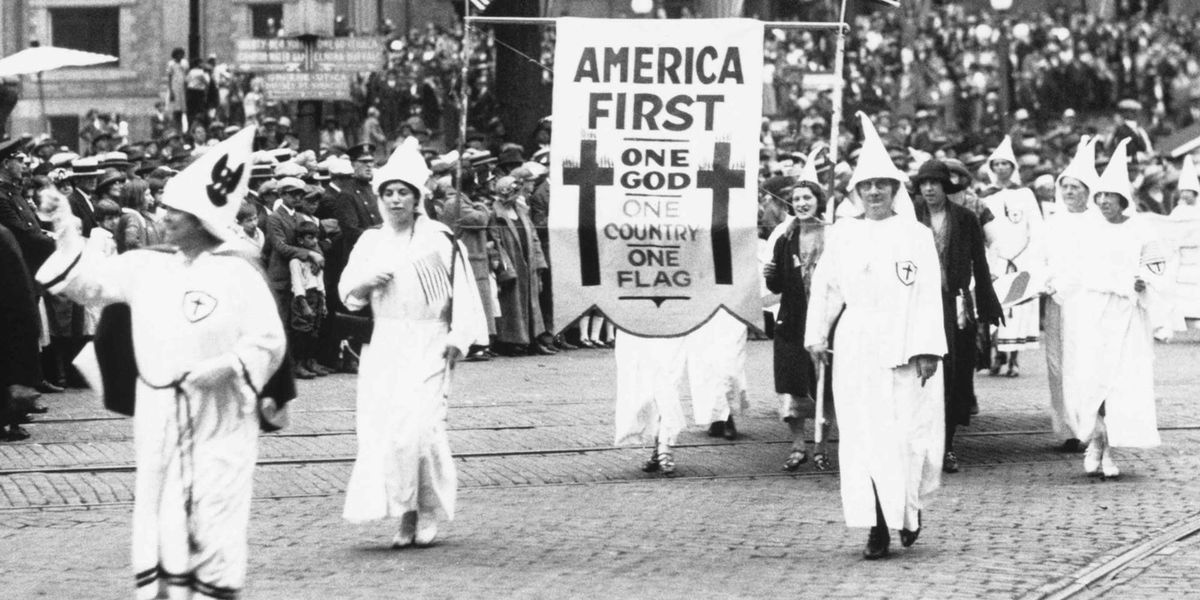
There is a rhythm to American history—a pulse that rises in moments of uncertainty, when people feel the world changing faster than they can understand. In those moments, some reach for hope and renewal. Others reach for purity. They look backwards, not forwards, searching for an imagined era of simplicity and moral clarity. And when they do, the same slogans return like echoes: America First. Make America Great Again. These phrases may feel contemporary, but they are not new. They belonged first to the 1920s—a decade marked by resurgent nativism, racial retrenchment, and a tightening fear of cultural change.
In the early twentieth century, “America First” was more than a political slogan. It was a demand that immigrants, Catholics, Jews, Black Americans, and anyone who did not fit the mold of white Protestant identity prove their loyalty—or be cast out. Politicians warned about “hyphenated Americans,” insisting that any identity beyond white, Protestant, and native-born made a person suspect. When Warren G. Harding ran in 1920 on a promise of a “return to normalcy,” it was a return defined by exclusion—a return to the comfort of cultural sameness and closed borders.
This message was the perfect match for the moment’s most powerful hate movement: the revived Ku Klux Klan. By the 1920s, the Klan had rebranded itself not as a band of hooded night riders but as a civic and religious order. They marched in daylight parades. They held charity picnics. They flew American flags. They called themselves the defenders of “100 percent Americanism.” Their enemies were not just Black Americans—they targeted Catholics, Jews, immigrants, and anyone who did not conform to their vision of a culturally pure nation. Their propaganda insisted that America was under siege and needed to be protected from “outsiders” who threatened to dilute its greatness.
This atmosphere led directly to the Immigration Act of 1924, one of the most sweeping and discriminatory immigration laws in U.S. history. It shut the nation’s door to entire regions of the world, tilted the population in favor of Northern Europeans, and declared—explicitly—that America’s greatness was something that could be preserved only by limiting who could join it. The logic was simple: If America is fragile, then diversity is dangerous.
A century later, the language has shifted, but the architecture remains intact. “Make America Great Again” invokes the same mythic past—an imagined golden age of moral purity, cultural uniformity, and national strength. The villains have been renamed, but the narrative is unchanged. The immigrant is still framed as a threat. The cosmopolitan is still cast as disloyal. The outsider is still painted as corrupting the nation’s soul. And once again, the call for “restoration” is framed not as bigotry but as patriotism.
This is the ideology political theorist Roger Griffin described as palingenetic ultranationalism—the belief in a nation’s rebirth through purification. It is the heartbeat of fascism. It thrives on the idea that a nation has fallen from grace and can only be saved by expelling the forces that polluted it. It seduces people by offering belonging, certainty, and purpose in a world that feels uncertain and overwhelming.
But history teaches us something crucial:
When patriotism is measured by purity, democracy cannot survive.
What the Klan offered then—and what modern nationalist movements offer now—is not strength, but escape. Escape from complexity. Escape from diversity. Escape from the responsibility of shared citizenship. It is easier to blame the outsider than to confront the nation’s own unfinished work.
The story of “America First” is not just a chapter in the past. It is a warning written in real time. When identity becomes a weapon, when patriotism becomes exclusion, and when nostalgia becomes ideology, a nation does not rise—it regresses. The slogans may change their font and their staging, but the outcome is always the same.
It promises resurrection.
What it delivers is ruin.