The Price of a Weekend: How Workers Fought and Died for the Eight-Hour Day

Today, the rhythm of our lives — five days of work, two days of rest — feels natural, almost inevitable. But that pattern was carved into being through blood and defiance. The eight-hour workday and the forty-hour workweek are not the inventions of benevolent industrialists or enlightened politicians. They are the legacy of ordinary workers who risked, and often lost, their lives in the fight against industrial exploitation. Their struggle began in the grim factories and foundries of the 19th century and reached its moral climax on the streets of Chicago and Milwaukee — where the dream of “Eight hours for work, eight hours for rest, and eight hours for what we will” became both a rallying cry and a requiem.
At the dawn of the Industrial Age, American workers faced punishing conditions. Fourteen-hour days were common. Children as young as eight toiled beside their parents, inhaling coal dust and metal shavings for pennies. There were no weekends, no safety laws, no workers’ compensation. Laborers were fired for getting hurt or for organizing, and company guards enforced the bosses’ will with clubs and bullets. In the aftermath of the Civil War, as railroads and factories transformed the nation, a new class of industrial magnates rose to power. They amassed fortunes built on the exhaustion of their workers, while preachers and politicians defended this order as the “natural law” of capitalism.
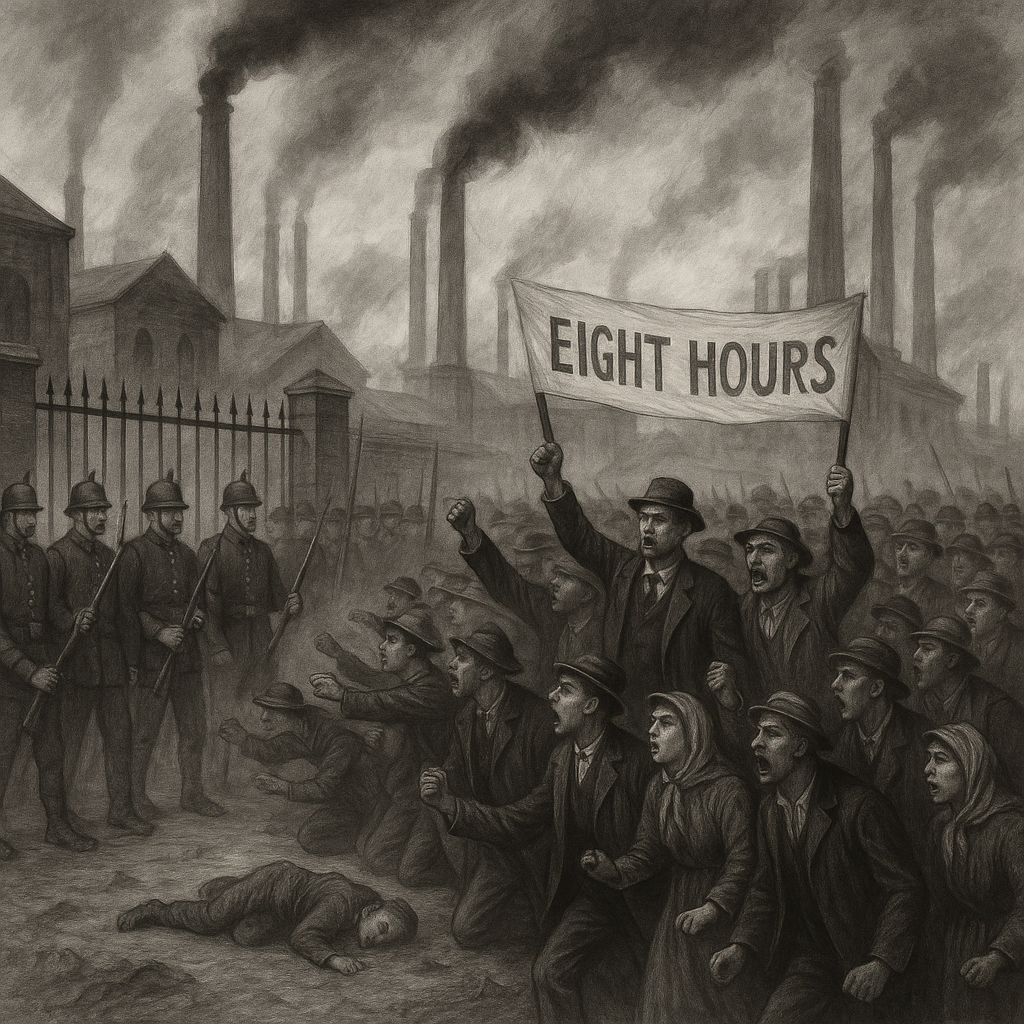
The first organized pushback came in 1866 when the National Labor Union petitioned Congress for an eight-hour day. It was ignored. A decade later, as mechanization increased output but drove wages down, workers grew restless. By 1886, frustration erupted into a nationwide movement. On May 1st, hundreds of thousands of American laborers — from dockworkers in New York to carpenters in San Francisco — went on strike. Chicago became the epicenter, led by anarchists, socialists, and trade unionists who envisioned a more democratic workplace. At the McCormick Reaper Works, police killed several unarmed strikers, igniting outrage. The next day, a rally at Haymarket Square began peacefully. As the evening wore on, police advanced to disperse the crowd. Then came an explosion — a bomb thrown by an unknown hand. Chaos erupted, and police opened fire into the crowd. Seven officers and several civilians were killed, though most of the dead and wounded were workers.
The aftermath was a travesty of justice. Eight labor leaders were arrested and charged not for throwing the bomb, but for their beliefs. They were convicted in a trial widely recognized as a political purge. Four were executed. One took his own life in jail. They became known as the Haymarket Martyrs, and their deaths ignited a global movement for workers’ rights. Across the world, May 1st became International Workers’ Day — a holiday born not of celebration, but of mourning and solidarity.
But the struggle was not limited to Chicago. In Milwaukee, Wisconsin, another tragedy was unfolding at almost the same time. On May 5, 1886, thousands of workers marched peacefully through the streets, part of the same national call for the eight-hour day. They came from every trade — foundrymen, tanners, brewers, and ironworkers — and many were immigrants from Germany and Poland who carried deep traditions of European labor activism. The march was orderly, until the governor, fearing insurrection, ordered the state militia to protect the Bay View Rolling Mills, a massive steel plant that had refused to close. When the workers approached the gates, the militia opened fire. Seven were killed instantly — among them a 13-year-old boy named Henry Wojciechowski. The massacre shocked Wisconsin but failed to move its legislature. No one was prosecuted. The dead were buried quietly, but their sacrifice lit a fuse that would burn for decades.
The Bay View Massacre became a symbol of the human cost of industrial progress. It exposed the stark divide between the working class and the political elite, and it haunted Wisconsin’s conscience. The Socialist movement that later flourished in Milwaukee — one that elected mayors, founded cooperatives, and created some of the nation’s first public health systems — drew moral energy from those deaths. To the workers who survived, Bay View was not just a tragedy; it was proof that the system would kill to preserve its power.
In the decades that followed, labor battles spread across the country. From the Pullman Strike of 1894, when federal troops killed dozens of railway workers in Chicago, to the Ludlow Massacre of 1914 in Colorado, where miners and their families were burned alive in a tent colony, the American labor movement wrote its history in blood. Yet through these dark years, the idea of a humane workday refused to die. Wisconsin again played a key role: under progressive leaders like Robert La Follette, the state became a laboratory for labor reform, experimenting with minimum wage laws, workplace safety standards, and unemployment insurance decades before the federal government followed suit.
The turning point came with the Great Depression. As unemployment soared and wages collapsed, labor’s fight for survival merged with Franklin Roosevelt’s New Deal. In 1938, the Fair Labor Standards Act was signed into law, finally enshrining the forty-hour week, minimum wage, and overtime protections. It was the culmination of seventy years of struggle, from Haymarket to Bay View, from nameless millhands to national legislation. What had once been dismissed as radical now became the baseline of modern employment.
Yet history has a way of being forgotten once its victories are normalized. Today, corporate culture romanticizes overwork, while some political voices call for “rolling back labor regulations” in the name of efficiency. But to weaken the eight-hour day is to spit on the graves of the men, women, and children who were shot down in Milwaukee and hanged in Chicago for daring to dream of a fair life. They understood something we risk forgetting — that time is the most valuable thing a person has. The fight for the eight-hour day was not just about rest. It was about reclaiming a piece of our humanity from a system that would have consumed every waking hour if left unchallenged.
The next time you leave work on a Friday and breathe in the freedom of a weekend, remember that this ordinary joy — these two days of life reclaimed — were purchased with courage and sacrifice. The names of those who died at Bay View may not be taught in schools, and the Haymarket Martyrs may be reduced to a footnote in textbooks, but their struggle built the world we live in. The weekend is their monument. And every worker who clocks out after eight hours honors their unfinished dream — that human dignity should never be measured by productivity alone.