The Private Equity Model is Cannibalizing America

There is a quiet violence happening in America — not the kind that cracks skulls in the street or fires bullets into crowds, but the kind that hollows out the systems ordinary people depend on to simply live. It is the violence of extraction disguised as strategy, destruction disguised as modernization, and greed disguised as efficiency. It has a name: Private Equity. For decades, the American public was told a simple story: let capital operate freely and the market will innovate; remove regulation and prosperity will follow; let the most financially sophisticated manage our institutions, and they will make them stronger. But capital did not build. Capital consumed.
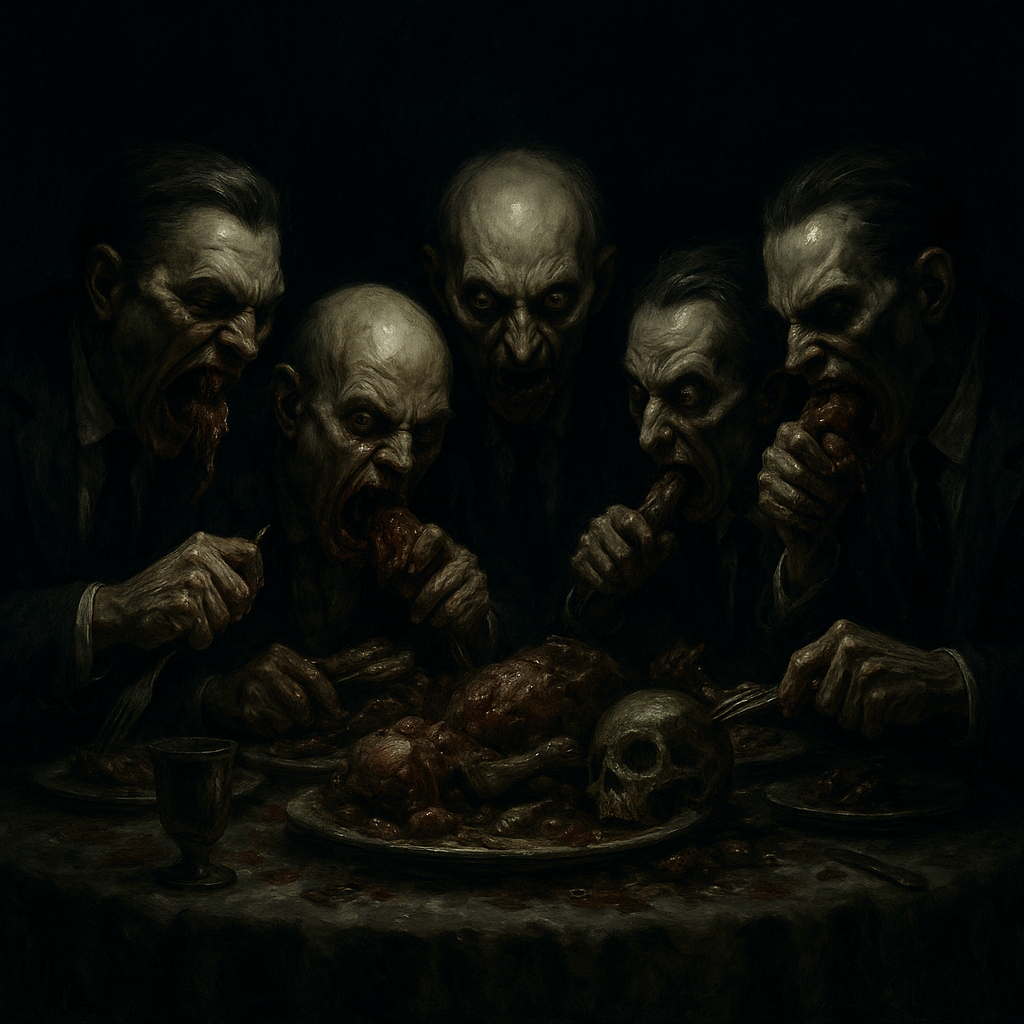
Private equity firms do not behave like investors who nurture and grow. They behave like harvesters. They buy a functioning institution, load it with debt so the institution owes the financiers money simply for existing, extract every dollar that can be removed, and leave. It is not a business model. It is a locust model — designed to feed on living structures until they collapse. One former Bain Capital analyst once summarized the model bluntly: “The point of private equity is not to run companies. The point is to extract as much value as possible — before the host dies.” The language is clinical, but the consequences are human.
Consider healthcare. Private equity has bought hospitals, nursing homes, hospice chains, ambulance companies, and emergency staffing groups. These are not luxury markets. These are the places where people are born, where their lives are saved, where they die. When a private equity firm acquires a hospital, its goal is not to improve care. Its goal is to convert that hospital into a profit engine. The changes follow a predictable recipe: reduce staff, outsource nurses, cut janitorial services, defer maintenance, eliminate less profitable departments like labor & delivery, and aggressively raise patient billing. And when the hospital is drained — when the town’s medical capacity has been bled dry — the owners walk away and call it restructuring. As one emergency physician put it, “We are being skinned alive.”
Rural hospitals across the United States did not fail because no one needed them. They failed because they were targeted. Private equity discovered it could buy the hospital, sell off the land beneath it, borrow against its assets, siphon the revenue streams, and then allow the institution to collapse under the weight of engineered debt. The result is not just an abandoned building. It is a community where a heart attack becomes fatal because the nearest emergency room is now seventy miles away. It is a region where childbirth happens in the backseat of a car. It is a town where catastrophe becomes geography.
The same model has gutted journalism. Private equity did not buy newspapers because newspapers were dying; it bought newspapers because they were still profitable, and their buildings and printing infrastructure were valuable. So they were acquired, staff was fired, investigative reporting was eliminated, and the presses were sold for scrap. Local news — the mechanism by which citizens know what their leaders are doing — was dismantled for short-term financial gain. “Democracy dies in darkness,” The Washington Post says. What must be added is this: darkness is not natural. Darkness is manufactured.
This is not merely economic policy. It is internal colonialism. What European empires once did to colonized lands — extract the resources, destroy local capacity, replace citizenship with dependency — the United States is now doing to itself. The towns collapsing across the Midwest and Appalachia, the neighborhoods without grocery stores, the counties without hospitals, the cities without newspapers — these are not victims of fate. They are victims of deliberate financial engineering.
A nation does not fall when its buildings burn. A nation falls when its institutions are harvested and sold for parts. The philosopher who wrote, “A society grows great when old men plant trees whose shade they will never sit in,” understood that civilization survives only when we build forward. Private equity is the inverse of that idea. It is the uprooting of the orchard for firewood. The burning of the seed grain for a single winter’s meal.
The real divide in America is not left versus right. It is extractors versus caretakers. Those who treat the country as a body to be fed and sustained, and those who treat it as a carcass to be stripped. The question now is whether there is enough left to rebuild — or whether we are living in the late stage of the great American liquidation.
And if that is true, the next question is even more urgent:
Who will choose to stop the harvest and begin the planting again?