The Quiet Road to Theocracy: How Christian Nationalism Mirrors the Taliban
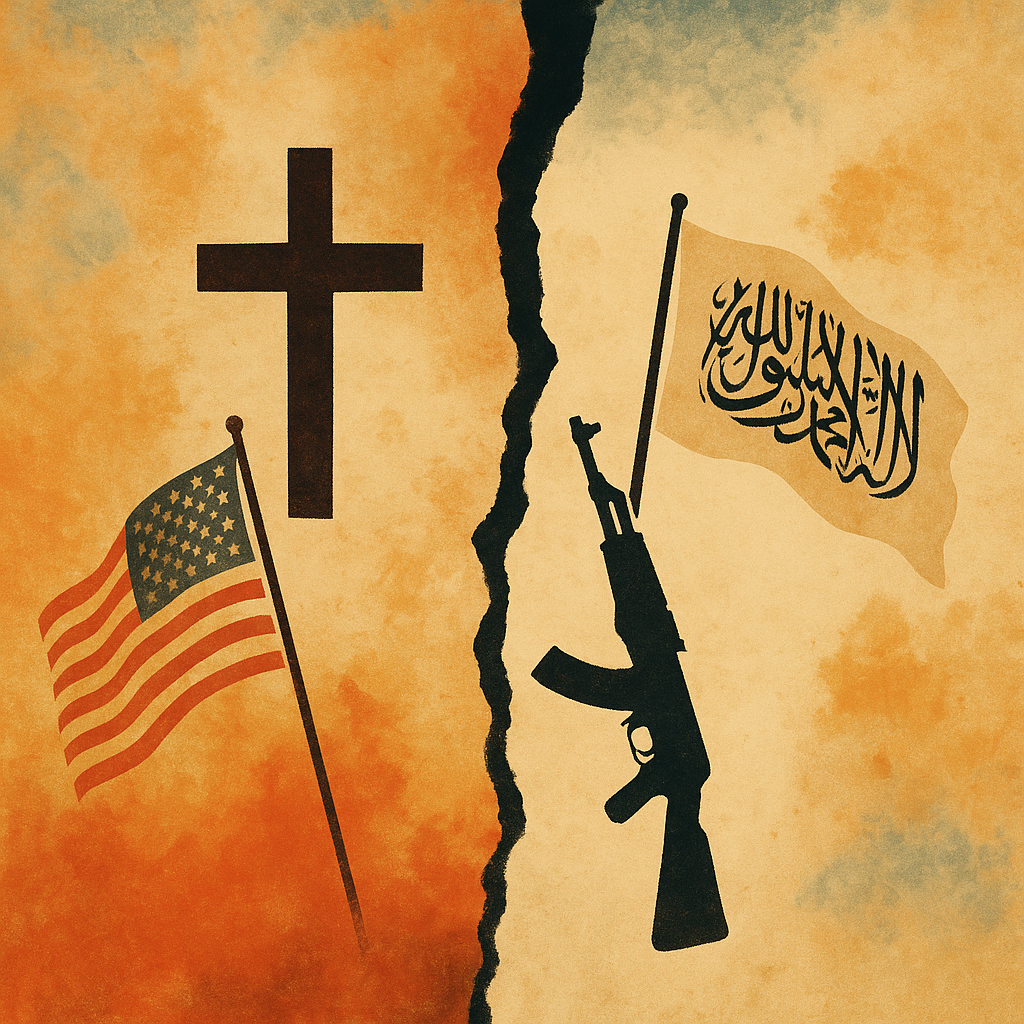
In the American imagination, the Taliban represents an extreme: a religious movement that seizes political power and shapes every aspect of public life according to its doctrine. It is easy to look at that phenomenon as something distant, foreign, and unthinkable on our soil. But the unsettling truth is that the logic behind the Taliban’s rule—the belief that the state must enforce one “true” faith—is not unique to Afghanistan. It is alive inside our own borders under the banner of Christian nationalism.
Christian nationalism is not about personal faith, spiritual devotion, or moral guidance. It is a political ideology. It asserts that the United States was founded as a Christian nation, that Christianity should guide lawmaking and civic identity, and that those who do not adhere to this specific form of Christianity are lesser citizens. In this ideology, faith is not a personal journey—it is a national requirement. That is the key parallel. The Taliban enforces Islam as state identity. Christian nationalism seeks to enforce Christianity as national identity. The method differs in scale and severity; the principle is the same: use political power to impose religious authority.
The Founding Fathers anticipated this danger. They had seen how state-backed religion corrupts both faith and government. Their solution was radical for the time: the First Amendment. “Congress shall make no law respecting an establishment of religion, or prohibiting the free exercise thereof.” The intention was not merely to avoid conflict; it was to protect the soul of religion itself. Thomas Jefferson wrote that this principle built “a wall of separation between Church and State.” James Madison argued this separation was necessary to preserve the “purity” of both. They understood that once religion becomes a tool of government, it stops being faith and becomes power.
Christian nationalism erodes that wall by redefining religious freedom. Instead of meaning freedom for all, it is manipulated to mean the right to impose one group’s belief on everyone else. That shift turns inclusion into exclusion, freedom into obedience. You begin to hear familiar claims: only certain believers are “real Americans,” laws must reflect one theology, and those who dissent are enemies of the nation. This is precisely how religious identity becomes weaponized. It is how pluralism begins to die.
To be clear, the comparison to the Taliban is not about tactics. It is about trajectory. The Taliban did not begin with violence; it began with a narrative of moral restoration. It claimed divine mandate. It insisted society must be remade according to its religious vision. Christian nationalism echoes that same language—of moral decline, of chosen righteousness, of divine entitlement to rule. The erosion of democratic norms rarely announces itself with gunfire. It arrives wrapped in certainty and scripture.
The point is not to condemn Christianity. The point is to defend it—along with every other faith, and the right to have none. The only place religion can remain authentic and alive is in the realm of conscience, not coercion. The Founders were not hostile to religion; they were its guardians. They understood that belief chosen freely is belief with depth, meaning, and dignity. Faith that requires the force of the state to sustain itself has already hollowed out its own spirit.
When the state begins to speak with the voice of one religion, the first freedom to fall is thought. The second is belonging. The third is humanity. The lesson written across history—from Europe’s confessional wars to Afghanistan’s theocracy—is that the merging of religion and political power does not elevate faith; it degrades it. It does not strengthen a nation; it fractures it into insiders and outsiders, saved and condemned.
We do not need to wait for theocracy to arrive in its most violent form to recognize its shadow. We only need to watch what happens when someone says that one religion alone defines America. That is the moment the Founders feared. That is the moment the First Amendment was written to resist. And that is the moment we are living in now.