The Rough Draft of America
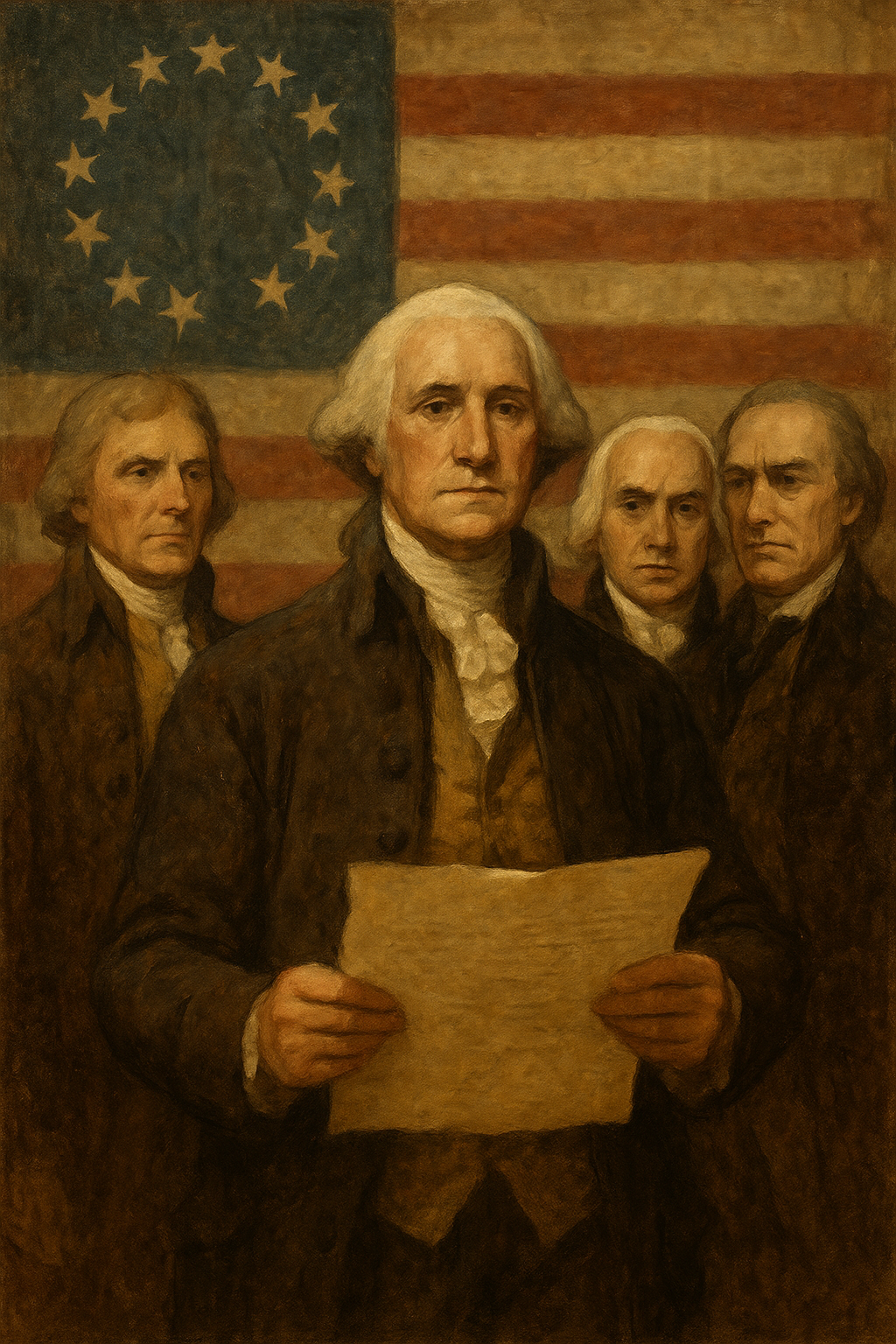
Most of us grow up thinking the U.S. Constitution is the single founding document that birthed America — as if the nation leapt into existence fully formed in 1787. But that’s not quite true. The Constitution was actually a do-over. A second draft. The first attempt at self-government — the Articles of Confederation — was so weak, so dysfunctional, that it nearly destroyed the young republic before it ever had a chance to stand. And that failure tells us something profound about the balance between freedom and power, a lesson the modern GOP has somehow chosen to ignore.
When the Revolutionary War ended, the last thing the states wanted was another king. They had just bled for eight long years to escape one. So when they sat down to design their first government, their guiding principle was simple: whatever Britain was, do the opposite. The result was the Articles of Confederation — a “firm league of friendship.” It sounded noble and cooperative, but it was really a pact among states that didn’t trust each other, or anyone else, to hold real authority.
There was no president, no executive branch, no national court system, and no power to tax or raise an army. Each state printed its own money, passed its own trade laws, and wielded the same single vote in Congress — whether it was mighty Virginia or tiny Rhode Island. Congress could declare war, but it couldn’t pay for one. It could ask states for soldiers, but couldn’t compel them to send any. It could coin money, but so could every state — a recipe for economic bedlam. James Madison later wrote that under the Articles, “the laws of the United States are a dead letter — the Confederation is but a shadow without the substance.”
Eventually, the weaknesses of this fragile “league of friendship” became impossible to ignore. The nation was drowning in debt, soldiers went unpaid, and states began fighting trade wars with each other like rival countries. As George Washington lamented in a 1786 letter, “We are fast verging to anarchy and confusion.” He wasn’t being dramatic — he was watching the revolution’s victory unravel in real time.
Then came the breaking point: Shays’ Rebellion. In Massachusetts, farmers who had fought in the Revolution found themselves crushed by state taxes they couldn’t afford. Many were veterans who’d risked everything for independence, now losing their farms to foreclosures and debt collectors. When they rose up in protest — led by Daniel Shays — they did exactly what they’d done against the British: grabbed their muskets. The national government, powerless and broke, could do nothing to stop them. Washington wrote, “If government shrinks, or is unable to enforce its laws… anarchy and confusion must prevail.”
For many of the nation’s founders, that rebellion was a wake-up call. Alexander Hamilton saw it as proof that “a nation without a national government is an awful spectacle.” He and others called for a convention to “revise” the Articles, though in truth they were planning a revolution of their own — this time not against a king, but against chaos.
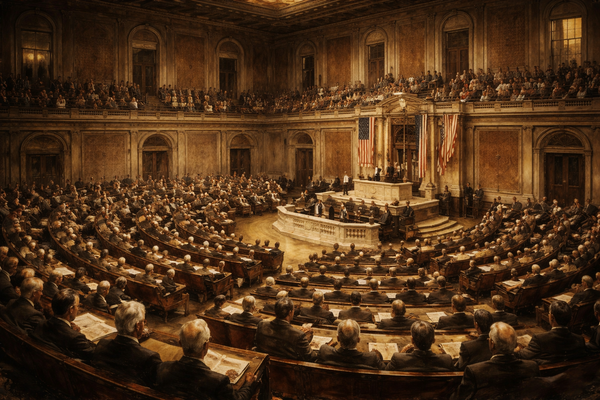
When delegates met in Philadelphia in 1787, they didn’t just patch holes — they built an entirely new system. They had seen firsthand what a weak government looked like, and they were determined never to repeat it. As Madison put it, “Liberty may be endangered by the abuses of liberty as well as by the abuses of power.” That line captures the heart of what they were trying to fix: the realization that unrestrained freedom, without structure, could destroy itself just as surely as tyranny could.
The debates that summer were fierce and deeply human. Large states and small states fought over representation. Slave states and free states fought over humanity itself. Northern merchants and southern planters argued over economics, security, and the very meaning of freedom. What emerged from that furnace of compromise was not divine perfection, but deliberate balance.
The Great Compromise split Congress into two chambers: a House of Representatives based on population and a Senate with equal votes for each state. But the most painful compromise of all came over slavery — the infamous Three-Fifths Clause — where enslaved people were counted as three-fifths of a person for representation. Madison privately called slavery “the most oppressive dominion ever exercised by man over man,” yet still agreed to the compromise, fearing the fragile union would collapse without it. The Constitution was not built on purity; it was built on survival.
When the document was sent to the states for ratification, a new battle erupted — Federalists vs. Anti-Federalists. Federalists like Hamilton, Madison, and John Jay argued in their Federalist Papers that a strong national government was essential for stability. Hamilton warned, “Why has government been instituted at all? Because the passions of man will not conform to the dictates of reason and justice without constraint.”
The Anti-Federalists — men like Patrick Henry and George Mason — saw things differently. Henry thundered that the proposed Constitution “squints toward monarchy,” and Mason refused to sign it without a Bill of Rights. Their fears were not unfounded. They worried about distant power, centralized control, and the return of tyranny. And so, to win ratification, the Federalists promised a Bill of Rights — ten amendments that would guard the people’s liberties against the government they were creating.
That tension — between liberty and order, individual rights and collective power — became the DNA of the American system. It was a system built to evolve, to correct, to change. Jefferson, writing from Paris, famously said, “A little rebellion now and then is a good thing… It is a medicine necessary for the sound health of government.” Washington disagreed, calling rebellion “anarchy’s weapon.” But together, their disagreement captures the paradox at the heart of American democracy: freedom and authority must coexist in constant tension.
And here’s where the modern GOP’s version of “originalism” goes off the rails. When conservatives today claim to be “originalists,” they often don’t mean they want to return to the Constitution as written. They mean they want to return to the world before it — back to the Articles of Confederation, when the federal government was weak, the states were sovereign, and national law barely existed. Their “original” America wasn’t the constitutional republic the framers designed after hard lessons — it was the fragile confederation that failed because it couldn’t hold a country together.
That first draft didn’t collapse because the founders lacked courage. It collapsed because they misunderstood power. They mistook decentralization for freedom, and in doing so nearly lost both. The Constitution — flawed, contested, and evolving — was their answer to that mistake. It was not written to freeze the world of 1787 in amber, but to create a framework capable of withstanding the centuries to come.
When modern politicians wrap themselves in “original intent” while dismantling the very mechanisms that hold our union together — federal authority, civil rights protections, democratic norms — they’re not channeling Madison or Hamilton. They’re channeling the ghosts of the Articles of Confederation.
The framers wrote the Constitution because they learned, painfully, that freedom without unity is fragility — and power without accountability is tyranny. They feared both. They balanced both. That was their genius.
The lesson of the Articles is simple: a government too weak to act is no government at all. As Hamilton warned, “A feeble executive implies a feeble execution of the government. A feeble execution is but another phrase for a bad execution.” The founders tore up their first draft because it could not protect the people, preserve the union, or uphold the very liberty it claimed to serve.
The question for us now — as some try to resurrect that broken vision — is whether we’ve learned from their failure. The framers didn’t worship the past; they rewrote it. They didn’t fear change; they used it to survive. And in that spirit, the Constitution endures — not as a monument to what was, but as an invitation to keep building what might yet be.