The Script Is Already Written
When a government begins to align its language, its money, and its fear, it is rarely coincidence. It is choreography. Power does not simply react to events—it rehearses for them. It lays the foundation for a crisis before a crisis exists. And when the moment arrives, it can claim inevitability. It can point to the very conditions it helped create and say, See? We warned you.
Right now, we are living inside that rehearsal.
Across history, authoritarians have relied on a familiar sequence:
Create a threat. Fund the response. Moralize the crackdown.
Once those three steps are complete, the rest takes care of itself. The public begins to mistake repression for protection, obedience for patriotism, and silence for safety.
We can see this pattern forming through four separate but interconnected moves—an executive order, a funding expansion, a rhetorical campaign, and a public display of force.
First, the executive order.
Donald Trump’s designation of “Antifa” as a domestic terrorist organization was never operational. U.S. law does not allow domestic movements to be labeled as terrorist groups, and Antifa is not even a structured entity—it is a stance against fascism. But authoritarian projects live in the space between symbolic law and potential law. The order sits on paper like a loaded chamber. All it requires is a pretext. Authoritarianism does not need laws—it needs excuses.
Then came the funding.
Congress expanded ICE’s budget under the vague justification of “domestic threat preparedness.” No line item for humanitarian care. No emphasis on asylum reform. The money was earmarked for “coordination” of internal security—language wide enough to cover surveillance, detention, infiltration, and disruption of protests. ICE already operates in a legal gray zone, often exempt from the warrant requirements that bind local police. It can detain first and rationalize later. And now, it has the resources to expand that authority quietly, steadily, without oversight.
Next, the narrative.
Speaker Mike Johnson labeled the upcoming “No Kings” rally as “pro-Hamas,” “Antifa-backed,” and “anti-American.” This is a rhetorical fusion meant to collapse foreign threat, domestic dissent, and moral treason into one object of fear. It is the same play deployed after September 11, when to question the government was to “embolden the enemy.” The language is not careless. It is calculated to create social risk. Once the idea takes hold that dissent is disloyalty, most people stop speaking—not out of agreement, but out of fear of being seen.
And finally, the theater of force.
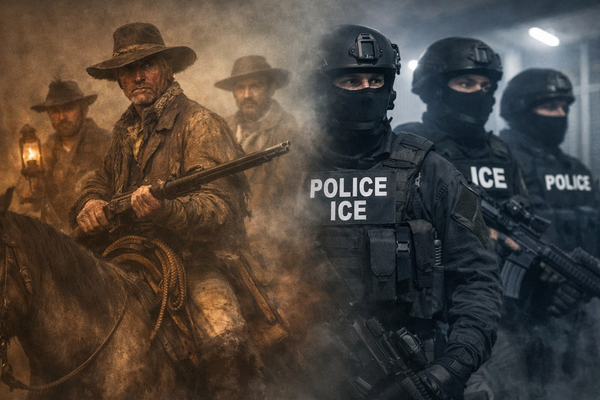
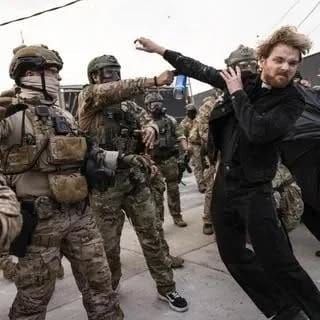
Governors like Kristi Noem have begun posting videos of militarized drills—armored vehicles, tactical formations, ICE agents moving like soldiers. These are not border exercises. They are performances. The performance is aimed outward, to remind the public who holds the monopoly on violence. But it is also aimed inward, training the enforcers to view the public not as civilians but as potential insurgents. The most dangerous shift in any government is not in laws—it is in the self-perception of those armed to enforce them.
Individually, each move can be explained away.
Taken together, they form a narrative scaffold.
A story is being pre-written.
The executive order defines the enemy.
The funding builds the muscle to confront it.
The rhetoric tells the public what to fear.
The drills teach the enforcers how to respond.
What remains is the spark—the “incident,” the “flare-up,” the “provocation.” It does not need to be large. A scuffle. A confused moment. A single officer who interprets a gesture as aggression. A lone loud voice in a crowd. That is all it takes for cameras to roll, headlines to crystallize, and the public to be told, This is disorder. This is chaos. Look how they threaten your safety. We must restore order.
This is how democratic backsliding happens—not with tanks rolling down Pennsylvania Avenue, but with televised “security responses” framed as unfortunate necessities. It happens when enough citizens believe that strength means control, and control means silence.
But patterns are not destiny.
They require participation to complete.
If protesters remain calm—if phones stay recording, if voices stay measured—then the script begins to break. Authoritarian choreography requires reaction. It needs panic. It needs escalation. Without it, the narrative collapses into absurdity. The power appears performative rather than protective.
If citizens listen closely to the language—if they notice when words like “stability,” “domestic coordination,” and “public reassurance” begin to replace transparency—then the illusion weakens. The spell loses its power.
If the public refuses to accept the premise that dissent equals danger, the engine stalls.
Maybe nothing will happen. Maybe the rally will be peaceful. Maybe no footage will emerge, no crisis will unfold, no headline will flash across the nation. I hope that is true. Truly.
But if the moment comes—if the confrontation plays out exactly as the choreography predicts—remember this:
The story was written before a single person stepped onto the street.
The stage was built.
The actors were prepared.
The cameras were ready.
None of it was accidental.
None of it was spontaneous.
It was rehearsal.
And in this moment, the most radical act of resistance is simple:
Refuse to play the part they have scripted for you.