The Second Amendment’s Selective Memory
The National Rifle Association did not begin as a reactionary political force, nor did it emerge as an absolutist defender of unfettered gun ownership. It began, in 1871, as a sporting and marksmanship organization founded by Union veterans who believed Americans were insufficiently trained with firearms after the Civil War. For much of its early life, the NRA supported regulation, cooperated with lawmakers, and treated firearms as tools to be managed rather than symbols to be worshipped. That history matters, because it exposes how recent, contingent, and politically shaped the modern gun debate truly is, and how deeply questions of race have guided where the lines were drawn.
For decades, the NRA backed gun control measures that today would provoke outrage from its own leadership. It supported the National Firearms Act of 1934, which restricted machine guns and short-barreled weapons. It supported the Federal Firearms Act of 1938, which required licensing of gun dealers. Its leaders routinely spoke of the legitimacy of regulation. In 1968, after the assassinations of Martin Luther King Jr. and Robert Kennedy, the NRA raised no serious objection to the Gun Control Act, which expanded background checks and limited mail-order firearms. At the time, the organization framed these laws as reasonable efforts to reduce crime, not as tyrannical overreach. The Second Amendment was rarely invoked as an absolute shield.
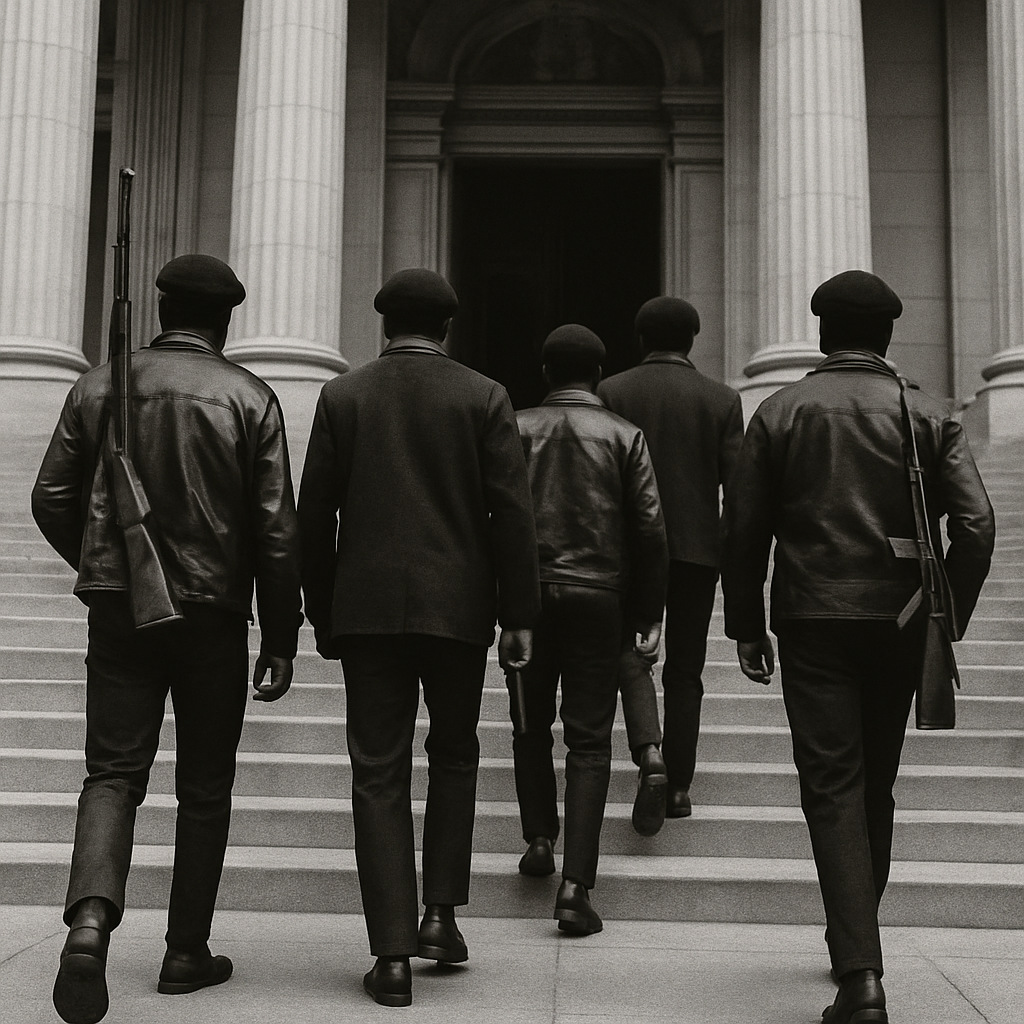
That posture shifted abruptly when the perceived threat changed. In the late 1960s, armed Black Americans began asserting their rights publicly, visibly, and unapologetically. The Black Panther Party for Self-Defense understood California law well enough to exploit it. Open carry was legal. Police harassment was constant. Armed patrols of Black neighborhoods were not symbolic gestures but tactical responses to real violence. When Panthers followed police officers with law books in one hand and rifles in the other, they were not violating the law. They were exposing its uneven enforcement.
The reaction was swift. In 1967, as Panthers carried firearms into the California State Capitol to protest proposed legislation, lawmakers rushed to pass the Mulford Act, which banned public open carry. The bill was signed by Governor Ronald Reagan, who declared, “There’s no reason why on the street today a citizen should be carrying loaded weapons.” He went further, stating that gun control was “a very legitimate measure,” and that the Second Amendment did not guarantee the right to carry weapons openly. The NRA supported the bill. So did much of white California. Armed protest was acceptable when it was hypothetical or rural or white. It became intolerable when it was Black, organized, and political.
This moment is impossible to disentangle from race. The same behavior that had been tolerated for decades became a crisis once it challenged the racial order directly. Armed white men were hobbyists, sportsmen, patriots. Armed Black men were a threat to public safety. Gun control, in this context, functioned less as a neutral policy tool and more as a boundary-enforcing mechanism. It defined who could safely be trusted with violence and who could not. The Mulford Act was not an anomaly. It was a pattern.
Historically, gun regulation in the United States has often been explicitly racial. Slave codes prohibited enslaved people from owning weapons. Reconstruction-era Black Codes restricted firearms access for freedmen. Jim Crow enforcement relied on selective policing and discretionary permits to ensure that the right to bear arms remained, in practice, a white privilege. Even when laws were facially neutral, enforcement rarely was. The Panthers understood this lineage. Their insistence on legal armed self-defense was a direct confrontation with centuries of controlled vulnerability.
The NRA’s transformation into a hardline absolutist organization did not occur until the late 1970s, when internal leadership was overthrown by a more ideological faction that fused gun rights with conservative identity politics. Only then did the Second Amendment become sacralized. Only then did compromise become betrayal. The irony is difficult to miss. The organization that once endorsed regulation helped build the mythology that regulation itself is unconstitutional, but only after gun ownership had been culturally recoded as white, rural, and conservative.
Today’s debates are haunted by this selective memory. The NRA invokes history while erasing its own. It frames gun control as an alien intrusion while ignoring how often it supported such laws when the armed were not perceived as a racial or political threat. It treats the Black Panthers as extremists rather than as constitutional literalists who tested the system and revealed its fault lines. Their legacy is uncomfortable because it exposes a truth many would rather avoid. Rights in America have rarely been abstract. They have been negotiated through power, fear, and identity.
The lesson is not that gun control is inherently illegitimate, nor that unrestricted gun ownership is a moral good. It is that the rules have never been applied evenly, and the rhetoric surrounding them has never been neutral. When we argue about the Second Amendment today, we are not simply debating safety or liberty. We are arguing over whose fear counts, whose power is presumed responsible, and whose self-defense is framed as dangerous. Until that history is acknowledged honestly, the conversation will continue to circle the same myths, mistaking tradition for truth and forgetting that the loudest defenders of absolutism once stood firmly on the other side.