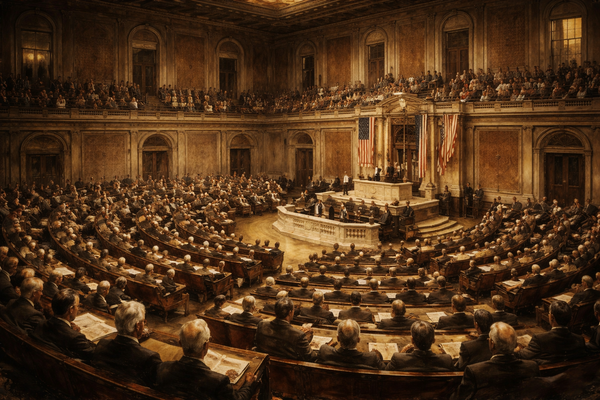
The Slow-Motion Coup: When Presidents Seize the Purse

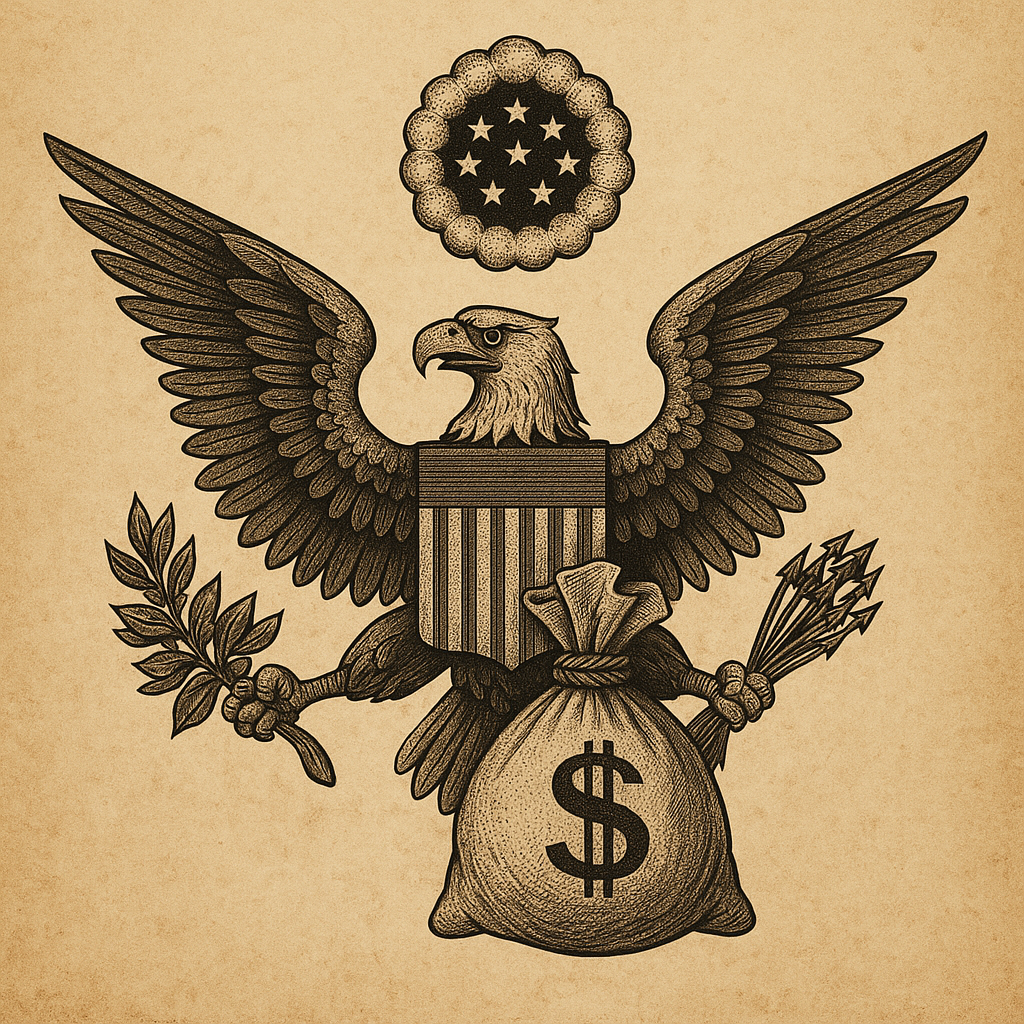
“All the perplexities, confusion, and distress in America arise not from defects in the Constitution or confederation, not from want of honor or virtue, so much as from downright ignorance of the nature of coin, credit, and circulation.” — John Adams
We are living through a constitutional crisis unfolding in slow motion — so gradual, so procedural, so bureaucratically polite that many Americans barely notice it. No militias surround the Capitol. No emergency decrees suspend elections. The coup is quieter than that. It is a shift in who controls the money — and therefore, who governs.
The Constitution is not ambiguous: Congress holds the power of the purse. It is the legislature’s most direct mechanism for checking executive authority. But in recent months, the presidency has again begun to move billions of dollars without congressional authorization, using “emergency” language, national security pretexts, or administrative reclassification to shift funds unilaterally. What matters is not the justification — it is the precedent. When the executive can spend, withhold, or redirect federal money at will, the separation of powers exists only on paper.
This is not the first time that line has been crossed. But each time it happens, the breach deepens.
In 1832, Andrew Jackson took on the Second Bank of the United States, claiming to defend the republic from financial aristocracy. But the real shift came when he removed federal deposits without congressional approval, placing them in state banks loyal to him. Congress condemned the move. The Senate officially censured him. Jackson shrugged. And in doing so, he rewrote the relationship between the branches. Senator Henry Clay saw the danger immediately. Jackson’s claim that the president alone could determine how public money was held and used, Clay warned, was “the beginning of executive usurpation.” He was right.
A century later, Richard Nixon did not seize or relocate funds — he simply refused to spend them. When Congress passed budgets for programs Nixon opposed, he blocked the money from flowing. He called it discipline. Congress called it unconstitutional. The fight gave us the Congressional Budget and Impoundment Control Act of 1974, a law intended to ensure that presidents must spend funds appropriated by Congress. It was passed alongside the investigations that revealed a president willing to treat the federal government as a personal instrument of power.
The lesson from both Jackson and Nixon is not merely that individual presidents overreached. It is that the constitutional order relies not only on written rules, but on norms of restraint. When a president acts first and forces Congress to react later, power shifts almost invisibly. When Congress is weakened by polarization, factionalism, or fear of political backlash, it cannot reclaim what was taken.
We have now entered a phase of institutional fatigue. A presidency accustomed to executive orders, emergency declarations, and administrative maneuvering no longer treats Congress as a coequal branch. Congress, fragmented and risk-averse, too often accepts this. And the public — overwhelmed, exhausted, and convinced that government is already dysfunctional — barely notices the stakes.
James Madison understood that the purse was the keystone of republican government. In Federalist No. 58, he called it “the most complete and effectual weapon” the people’s representatives possess. Take that away, even informally, and representative government becomes performance — a pageant of debate with no power behind it.
History teaches that republics do not collapse through a single dramatic act. They erode when extraordinary powers become ordinary, when exceptional measures become expected, when each violation of constitutional balance becomes precedent for the next. A nation wakes up one day to find that the presidency is no longer an office — it is a throne.
When Congress no longer controls spending, the people no longer govern the government.
And when the people no longer govern, the republic has already changed form — long before anyone calls it what it has become.