Thomas Paine and the America That Tried to Forget Him
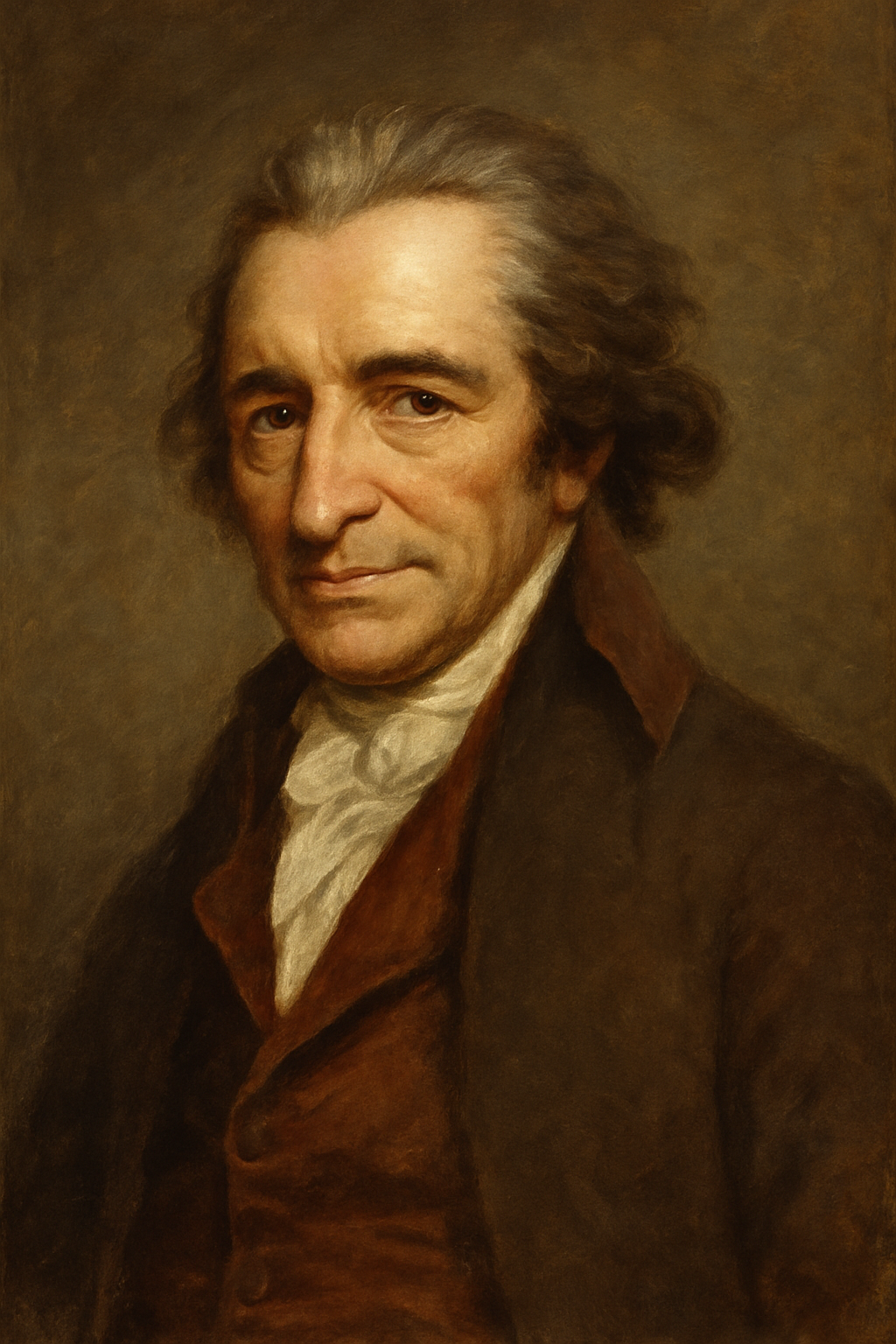
The popular memory of the American Revolution rests on a story so polished by repetition that it no longer bears much resemblance to the world that produced it. We speak of liberty as though it emerged fully formed from Philadelphia, carried forward by a unified people in a steady march toward freedom. The messiness, discord, and radical energy of the period are softened into a civic fable. Few figures expose the gap between that fable and the historical reality as sharply as Thomas Paine. His grave, lost and unmarked for generations, stands as a fitting symbol of how thoroughly the country benefited from his genius and then quietly buried the man himself. What the nation chose to remember of Paine—and what it worked to forget—reveals more about the limits of the independence movement than about the man who helped ignite it.
Paine arrived in America in late 1774, an Englishman of modest means shaped not by elite schools or legal training but by the raw experience of watching authority misused. His imagination had been touched by Enlightenment thought but not disciplined by its systems; he carried no reverence for Locke or Rousseau and saw no reason to filter his indignation through the careful language of gentlemen. What he possessed instead was a clarity about power—who held it, how it was justified, and how it failed those outside the narrow circle of property and privilege. In an era when the patriot elite struggled to rouse ordinary people with arguments about the unwritten British constitution, Paine understood that the path to independence required a different voice. His achievement was not in discovering new political principles but in translating long-standing debates about legitimacy, natural rights, and sovereignty into a language that reached taverns, workshops, and farmsteads.
Common Sense, published in January 1776, did not argue with the British political tradition so much as reject its premises. Jefferson’s Declaration and Paine’s pamphlet both blamed the king, though both authors knew the crown no longer exercised such direct control. Constitutional nuance had no place in this rhetorical moment. Jefferson needed a villain recognizable to European monarchies; Paine needed a symbol that ordinary Americans already distrusted. They made King George that figure, not because he was personally responsible for the crises they listed, but because political persuasion often relies on simplifying the architecture of power. Modern readers sometimes take that language at face value, and the fiction becomes a historical misunderstanding. Paine himself understood the British system well enough to know that Parliament was the real center of authority. But what mattered more was the emotional truth: people felt oppressed, and the king, not an impersonal legislature, gave that feeling shape.
Paine went further than the patriot establishment wished. Independence for him was not a conservative defense of inherited rights; it was an invitation to build institutions anew. Henry May, in his study of the Enlightenment in America, saw in Common Sense a moment when men believed they could reshape their world, not simply separate from Britain but reconsider the legitimacy of rank, hierarchy, and all forms of imposed authority. When Paine wrote that Americans had it within their power to “begin the world over again,” he meant it. Many of the men who later stood at the helm of the republic did not. They sought autonomy from Britain, not a social or political revolution. Paine’s appeal broadened the movement beyond the propertied classes, drawing artisans, laborers, and small farmers into the conversation. In doing so, he created expectations that the patriot establishment neither intended nor desired to meet.
The speed and breadth of Common Sense’s influence are difficult to exaggerate. It became the first true bestseller in American history, read aloud in public squares, army camps, and rural parishes where printed material rarely traveled. Before its publication, support for full independence was scattered and hesitant. After it, the political atmosphere changed almost overnight. Paine gave the independence movement a popular base that the elite leadership could not create themselves. And when that base threatened to evaporate in late 1776 as Washington’s army collapsed, Paine again supplied the emotional argument that political leaders could not. The first of the Crisis papers, with its stark opening—“These are the times that try men’s souls”—shored up morale at a moment when defeat seemed imminent. Washington understood its power so clearly that he ordered it read to the troops. Paine was indispensable when the movement needed a voice that could reach men standing in frozen camps rather than chambers of assembly.
Yet Paine’s usefulness to the patriot establishment had limits. He believed revolutions should mean something—expanded political participation, a break with inherited privilege, a willingness to rethink not only who governs but how. The leading figures of the independence movement wanted stability, not upheaval. As soon as the war moved toward its conclusion, Paine’s radicalism became a liability. His quarrels with Washington, Adams, and others reflected deep ideological differences: they saw democracy as a principle to be constrained; Paine saw it as a principle to be realized. In France, where revolution had become a genuine reimagining of society, he found a temporary home, though not without danger. His moderate stance during the Terror, insisting that even Louis XVI deserved due process, landed him in prison and nearly cost him his life. Only James Monroe’s intervention secured his release.
If Paine’s politics had unsettled American leaders, his religious views proved fatal to his legacy. The Age of Reason—a vigorous attack on scriptural literalism and clerical authority—made him a pariah in a society that still looked to Protestantism as a stabilizing force. Many of the founders privately shared deistic leanings, but they understood the social utility of religion and kept their skepticism discreet. Paine did not. He wrote with the same candor about religion that he applied to monarchy, and the result was swift ostracism. When he returned to the United States in 1802 at Jefferson’s invitation, the political elite made clear that his presence was tolerated only on the condition of silence. They had no interest in reviving the radical expectations he had once stirred. He died in 1809 with few mourners, denied burial in a Quaker cemetery, his remains later exhumed and misplaced in a strange odyssey that perfectly mirrors the nation’s discomfort with his memory.
The forgetting was deliberate. Paine’s vision of self-government—expansive, egalitarian, suspicious of concentrated power—did not align with the republic that emerged from the Revolution. Later generations, seeking a harmonized founding narrative, blurred his radicalism into a more comfortable patriotism. Historians like Sophia Rosenfeld have shown how thoroughly his voice was recast, transformed from a force demanding broad participation into a safe symbol of generic independence. The Revolution, in this retelling, becomes a unified triumph rather than a contested event filled with unrealized possibilities. But Paine reminds us that the independence movement was not the whole Revolution. It was the portion controlled by the men who ultimately defined the nation’s institutions, and they did not intend a sweeping transformation of political life. To remember Paine accurately is to remember that the Revolution contained a struggle over the meaning of authority and popular power—one that ended with the more radical vision suppressed.
The erasure of Thomas Paine is not merely a historical curiosity. It reflects a persistent American tendency to sanitize the past, to refashion dissenters into harmless patriots or forget them altogether. Paine believed ordinary people could govern themselves, not because they were perfect but because no authority was legitimate without their consent. His pamphlets carried the emotional charge of that belief, and his insistence that political power be accountable to the public remains one of the Revolution’s most challenging legacies. To confront his story honestly is to confront the unfinished nature of American self-government and the distance between the possibilities he imagined and the institutions that took shape.
We inherit a civic tradition shaped as much by the voices it silenced as by the ones it celebrated. Paine stands at that crossroads. He shows us how dependent the independence movement was on radical energy and how determined its leaders were to contain that energy once their aims were met. His life invites a quieter reflection: that democratic possibility is always fragile, that popular participation can be welcomed in one moment and rejected in the next, and that the stories nations choose to tell about their origins carry moral consequences. Remembering Paine returns us to the contested ground of the Revolution and reminds us that the promise of a government shaped by ordinary people is not a settled inheritance but a responsibility renewed by each generation.