Versailles on Pennsylvania Avenue
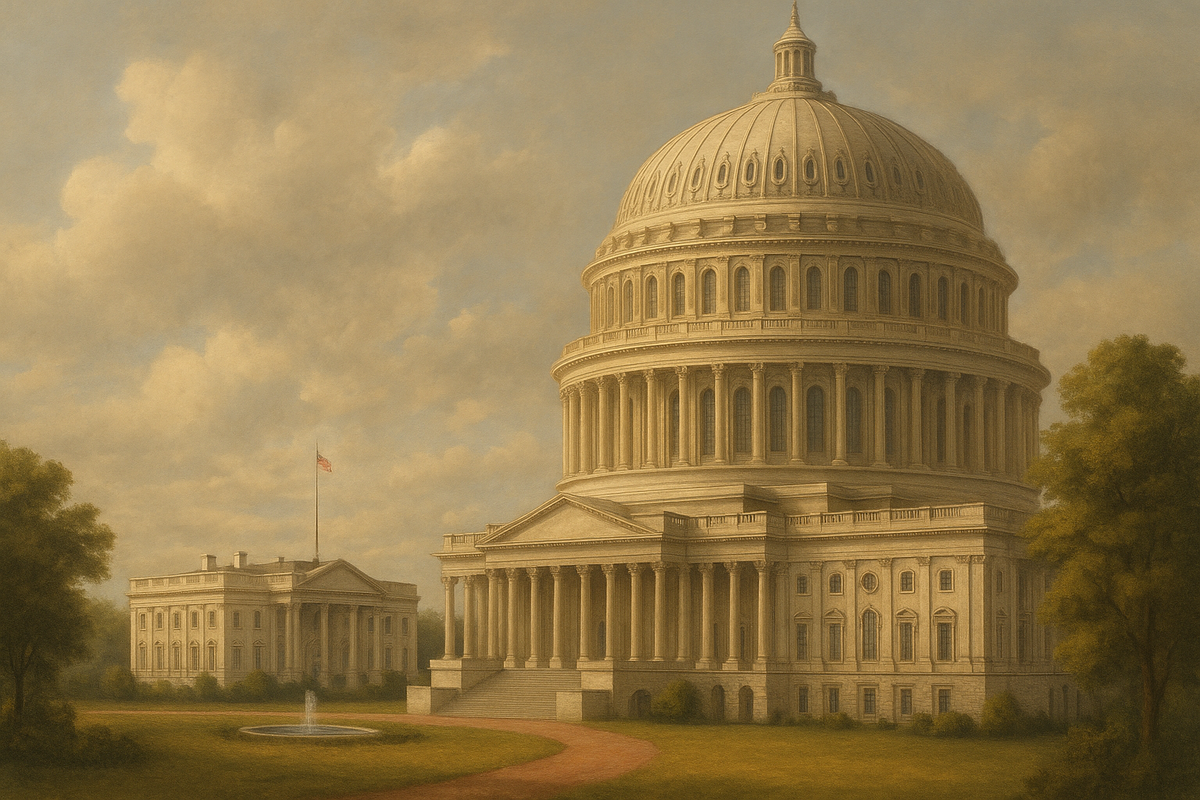
If Donald Trump builds his planned ballroom at the White House, it will be the largest addition to the building in nearly a century. A gleaming, 90,000-square-foot monument of mirrors and marble — designed for galas, fundraisers, and flattery — it would tower over the South Lawn as a literal hall of power. But ironically, Trump’s ballroom would bring the White House closer to its original 1790 design: not a house at all, but a palace.
That first design came from Pierre Charles L’Enfant, a Frenchman who had fought for the American cause in the Revolution. His vision was unapologetically European: three grand stories, over 700 feet in length, capped by a dome to rival the Capitol’s, and flanked by four detached wings to house an enormous presidential court. It was a palace worthy of Versailles or Compiègne. And that was precisely the problem. George Washington took one look and said no. He had just led a revolution against monarchy — he would not inaugurate a new one in marble. The architect was dismissed, and an Irishman named James Hoban was chosen instead. Hoban’s design was elegant but restrained: two stories instead of three, one rectangular building instead of a sprawling complex. A residence, not a throne room.
It was known thereafter, quite deliberately, as the President’s House — a name that later softened into the White House. The message was clear: this was not the home of a king, but the office of a citizen, limited by law and equal before it.
For the next half-century, that vision held. The early republic was cautious about power. Washington, Adams, Jefferson, and Madison all served within the modest bounds of the Constitution. Congress dominated national policy, and the executive branch was little more than a skeleton crew. When expansion finally came to Washington, D.C., it was not the White House that grew but the Washington Monument — a marble needle built in 1848 to honor the first president’s restraint. The capital’s skyline celebrated self-control, not supremacy. Then came the Civil War.
Abraham Lincoln faced a crisis unlike any before. To preserve the Union, he seized powers that would have scandalized Washington: suspending habeas corpus, jailing journalists, blockading ports, and issuing the Emancipation Proclamation — a military order freeing enslaved people in Confederate states. Legally, it was murky at best. The Constitution gave Congress, not the President, the power to make law. But Lincoln argued that the Constitution’s deeper mandate — to preserve, protect, and defend — allowed him to act beyond ordinary bounds in extraordinary times. He described it with characteristic simplicity: “Was it possible to lose the nation, and yet preserve the Constitution?” If one perished, he reasoned, so would the other.
Lincoln’s presidency thus planted a seed — that in times of emergency, the President could interpret necessity as authority. It was a noble abuse, perhaps, but an abuse nonetheless. When the war ended, Congress reasserted itself, ratified the Thirteenth Amendment, and restored the legislative balance. But the seed remained buried in the soil of American politics, waiting for the next crisis to make it sprout.
By the dawn of the 20th century, crisis arrived again. The industrial revolution had turned the United States into a machine of astonishing production — and astonishing inequality. Children worked in factories, forests vanished, and monopolies ruled with iron fists. The presidency, once designed to administer laws, was now too weak to govern the industrial state. Theodore Roosevelt recognized this and expanded the office accordingly. He created new executive agencies — the Forest Service, the FDA, the Department of Labor — to regulate the titans of industry. But regulation required space, and the modest mansion could not contain the growing bureaucracy. So in 1902, Roosevelt built the West Wing — a modern office annex for the machinery of government. It was Congress-approved, modest in appearance, but symbolically monumental. The presidency had outgrown its parlor and stepped into an era of administrative power.
A generation later, his cousin Franklin Delano Roosevelt faced a deeper catastrophe: the Great Depression. Banks collapsed, bread lines stretched across cities, and despair threatened to tear the country apart. FDR’s New Deal aimed to rescue the nation with vast new programs — Social Security, the SEC, the NLRB — and the West Wing nearly tripled in size to accommodate the growing executive apparatus. When World War II erupted, FDR expanded again, adding the East Wing and the secret underground bunker known as the Presidential Emergency Operations Center. For the first time, the White House was both a command post and a fortress.
By 1945, both the building and the office were buckling under their own weight. Truman’s engineers found the White House “standing purely from habit.” Rather than rebuild in marble, he gutted it and installed a hidden steel frame — an invisible skeleton that mirrored the new steel frame of the modern presidency: the Department of Defense, the CIA, and the NSA. With those came a new justification for power — not crisis at home, but crisis abroad. Truman entered war in Korea without congressional authorization, arguing that America was already in a global struggle with communism. The Constitution said only Congress could declare war, but Truman claimed an inherent authority to act in defense of freedom.
The Supreme Court pushed back when Truman tried to seize private steel mills, warning that unchecked executive power would destroy the balance of the Constitution. Justice Robert Jackson wrote that “what is at stake is the equilibrium established by our constitutional system.” But even that decision, meant to restrain, provided a map for future presidents: powers shared, powers inherent, powers plenary — those exercised alone. And every president since has tried to redraw that map in his favor.
Ronald Reagan did more than test it — he embraced it. Preaching small government while expanding executive authority, he advanced the “unitary executive” theory: that all executive power belongs to the president alone. He began signing bills with “signing statements” declaring he would not enforce sections he deemed unconstitutional. Congress passed the laws; Reagan decided which parts would live. When independent investigators probed his administration, he claimed he could fire them at will. The Supreme Court stopped him — but one justice, Antonin Scalia, dissented, planting a flag for future presidents to reclaim even more control.
After 9/11, George W. Bush revived and weaponized Reagan’s theory. He claimed authority to wage preemptive wars, detain without trial, and spy on Americans, all in the name of a permanent war on terror. He issued over a thousand constitutional objections in signing statements — more than every president before him combined. What began as emergency powers under Lincoln had now hardened into routine. The East Wing bunker, once a relic of wartime fear, had become the symbol of an unending emergency presidency.
Barack Obama inherited those powers and normalized them. He expanded drone warfare, targeted killings, and executive action through the bureaucracy. The presidency no longer merely responded to crises — it relied on them. The White House no longer shrank after war; it adapted to perpetual war as its default condition.
And now comes Trump — and his ballroom. Ninety thousand square feet of gilded grandeur, funded not by Congress but by corporate donors and politically coerced settlements. It is a $250-million monument to private influence and presidential supremacy. The sponsors — Palantir, Google, defense contractors — are the new courtiers of Versailles. They buy favor with donations and receive access in return. It is not just vanity; it is a system. The same president who builds palaces also wages wars without authorization, fires inspectors general, and accepts gifts from foreign monarchs. Every check and balance the Founders designed is being rewritten in marble and gold leaf.
Look closely and you’ll see the full circle. The French palace that Washington rejected has finally arrived — just delayed by two centuries and funded by Silicon Valley instead of Versailles. A presidency once defined by humility has become a monarchy in all but name. The residence of a citizen has become the fortress of a ruler.
Yet history also shows the antidote. Every time the presidency has overreached — after Lincoln, after FDR, after Nixon — Congress has pushed back. It remains the only body that can tax, spend, and investigate. The only one that can turn the palace back into a house. Votes, oversight, and lawmaking may sound small next to gilded ballrooms and motorcades, but they are the foundation of the republic.
Washington understood this. He traded the palace for the porch, the crown for the Constitution. Whether that trade survives another gilded hall depends on whether Americans still believe Congress — not the president — represents their power. The White House began as a symbol of humility. It may yet end as a symbol of hubris. The question is not whether Trump builds his ballroom, but whether the people remember why Washington refused one in the first place.