When the Fringe Becomes the State


The Great Replacement theory was once the fever-dream of white nationalist message boards — a conspiracy claiming that non-white immigrants are being deliberately brought into the country to “replace” white Americans. But what begins on the fringe does not always stay there. In recent years, the rhetoric and visual language of replacement ideology has increasingly seeped into mainstream politics — and now, into the messaging of the U.S. government itself.
The shift became unmistakable when Immigration and Customs Enforcement published a statement declaring its mission was to prevent “illegal ideas” from crossing the border. The agency later backtracked, claiming it was referring to intellectual property, but the phrase revealed something deeper: the border was no longer being framed merely as a line to be protected. It was being framed as a cultural membrane — a barrier against ideological contamination. The idea that immigrants are not just foreign bodies, but carriers of foreign thought, is fundamental to replacement ideology. It implies that belonging is not a matter of law, but of identity — and that identity must be defended.
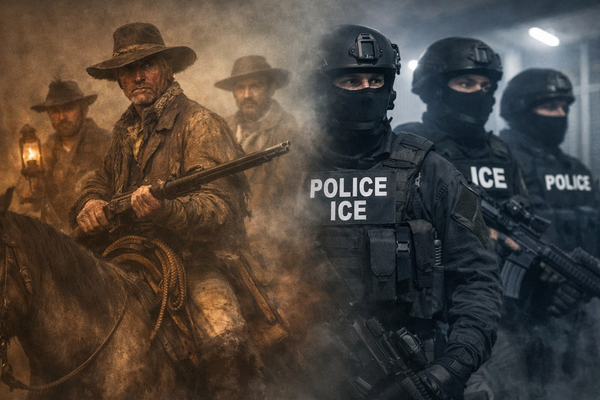
This language has not appeared in isolation. ICE’s promotional materials and recruitment imagery have shifted toward stylized, militaristic visuals that emphasize “heritage,” “homeland,” and “defenders.” The color palettes, the posture of figures, even the typography echo early twentieth-century nationalist propaganda. These aesthetics carry an unspoken message: immigration enforcement is not simply a bureaucratic function — it is a civilizational struggle. What is being defended is not territory. It is a cultural lineage.
As this language emerges inside state institutions, it intersects with a broader political chorus making the same claim. Tucker Carlson devoted entire monologues to “demographic replacement,” insisting it was a deliberate political strategy. Blake Masters said Democrats were “changing the demographics of the country.” Charlie Kirk declared that “the great replacement strategy is underway every single day.” Steve King, stripped of committee assignments for openly endorsing white nationalism, said the quiet part plainly: “Great replacement, yes.” What was once coded has now become spoken aloud.
When mainstream political figures adopt replacement rhetoric, it reshapes how immigration is understood. The debate no longer concerns labor, law, or humanitarian need. It becomes existential. Immigrants cease to be people. They become instruments of invasion. Policy becomes defense. Enforcement becomes warfare. Detention centers become “front lines.” Violence becomes preservation.
This language does more than justify cruelty — it normalizes it. When ICE raids tear apart families, when detention centers pack children behind fencing, when asylum seekers are treated as a contagion — the system reassures itself: this is protection. This is safeguarding the homeland. And as that narrative hardens, the machinery of the state begins to speak the same language as the very movements it once claimed to monitor as a threat.
This is how a conspiracy theory becomes infrastructure.
Once embedded in the logic of enforcement, it no longer needs to be said outright. It becomes the atmosphere. The default assumption. The unspoken frame determining who is seen as belonging, and who is seen as a threat simply by existing.
The danger is not the loud voices shouting the theory. It is the quiet normalization of its vocabulary inside institutions with handcuffs, holding cells, fleets, and guns.
A nation is defined not only by who it welcomes, but by who it imagines itself to fear. When the state begins to fear its future — and sees that future embodied in the bodies of newcomers — it turns inward, paranoid and violent. It becomes a country defending itself against its own evolution.
The Great Replacement theory is not a story about immigrants.
It is a story about what America believes it is — and what it is afraid of becoming.